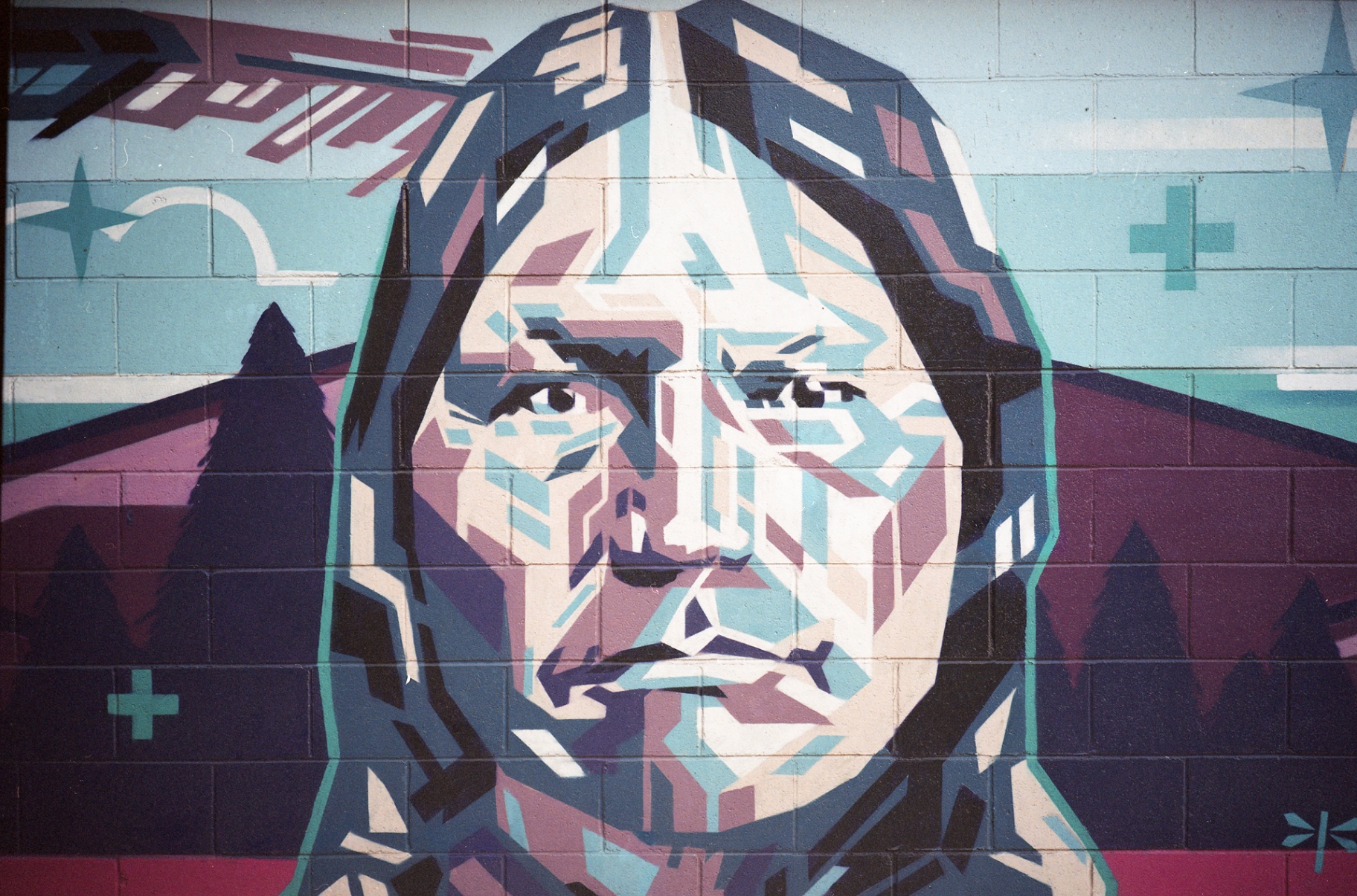
Cottonwood Square Murals
In 2022, four Native artists—Danielle SeeWalker, JayCee Beyale, Brent Learned, and George Curtis Levi—painted a series of Indigenous murals at Cottonwood Square. The community initiative began when former Niwot Business Association (NBA) president Tony Santelli proposed the murals to property owners Alex Chlebek and Maria Biernat. The specific historical focus of the project solidified in fall 2021 after Chlebek and neighboring building co-owner Bruce Warren visited the Sand Creek Massacre site. To execute the vision, property manager Rico Espinosa partnered with Leah Brenner Clack of Street Wise Arts to commission the artists. This effort was supported by funding from the Niwot Local Improvement District, the NBA, and the Niwot Cultural Arts Association.
The information on page is from extensive reporting by Vicky Dorvee for the Left Hand Valley Courier. Read more of her articles for the Left Hand Valley Courier.
“What Once Was”
Danielle SeeWalker
Húŋkpapȟa Lakȟóta · Standing Rock Sioux Tribe
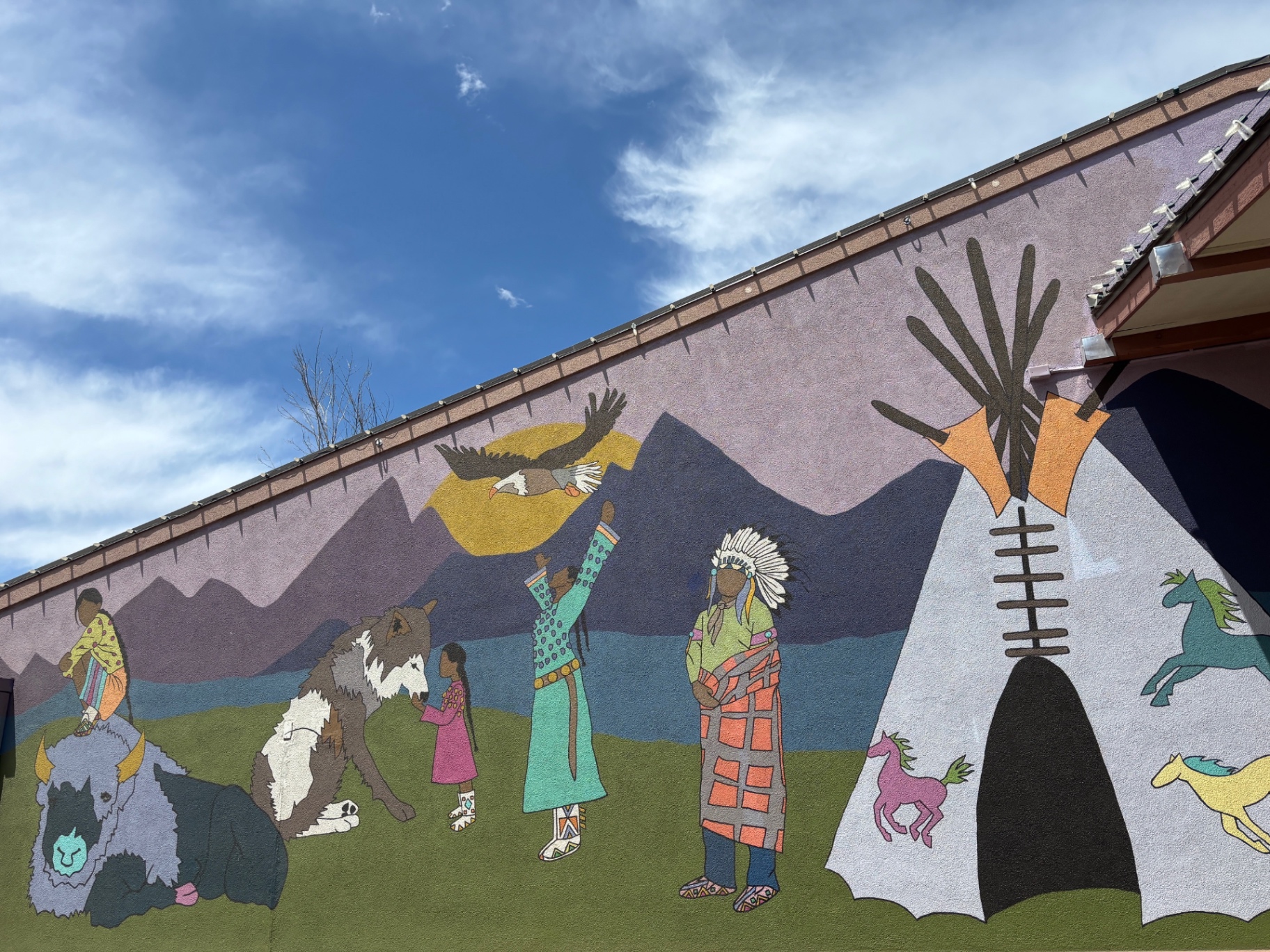
Painted across four days in intense 90°+ summer heat on the south facade of Abo's Pizza, SeeWalker's vibrant composition adapts traditional Northern Plains ledger art into a contemporary mural format. The artwork depicts a young girl wearing a traditional ribbon skirt astride a buffalo alongside a Southern Arapaho chief wrapped in a blanket, marking the complex historical transition into colonialism. A celebrated self-taught artist, curator, and author of Still Here, SeeWalker is a prominent advocate for regional tribal affairs, serving as a driving force behind Colorado's historic Mascot Bill and the Missing and Murdered Indigenous Relatives (MMIR) legislation. Her visual narrative draws directly from her grandmother's personal boarding-school survival story.
In the artist's words
“It's my own history. My own grandma grew up speaking only Lakota, and in a very traditional way… and then she was a boarding school student and she was forced to go through those changes. For so many of my peers and friends, it's their family story too.”
“It wasn't about the art itself. It's more about what's happening. It was our way of storytelling and documenting history.”
More from the Artist: seewalker.com
Source: Vicky Dorvee, Left Hand Valley Courier
Portrait of Chief Niwot
JayCee Beyale
Diné (Navajo Nation)
Because no verified archival photographs of Chief Nowoo3 exist, Beyale conducted meticulous historical research in Arapaho photographic archives to compose this definitive 40-by-8-foot public portrait on the south wall of the Jerry Sinor Building. Buffalo-shaped rain clouds materialize around the leader, symbolizing the spirits of ancestors still present in the valley. As a co-founder of the regional Creative Nations Art Collective based at the Dairy Arts Center in Boulder, Beyale approaches large-scale painting as a ceremonial act of weaving land, sky, and community relationship building together.
In the artist's words
“That purpose was to provide some sense of background and history to people who do not know who Niwot is, who do not know what Sand Creek really is, who do not know the relationships of settlers with indigenous people and what that was like. It's so important.”
“I just wanted to present the Arapaho people in the best possible way, to honor and recognize them for their presence and as the stewards of the land.”
More from the Artist: jayceebeyale.com
Source: Vicky Dorvee, Left Hand Valley Courier
“Genocide Sand Creek Massacre”
Brent Learned
Cheyenne and Arapaho Tribes
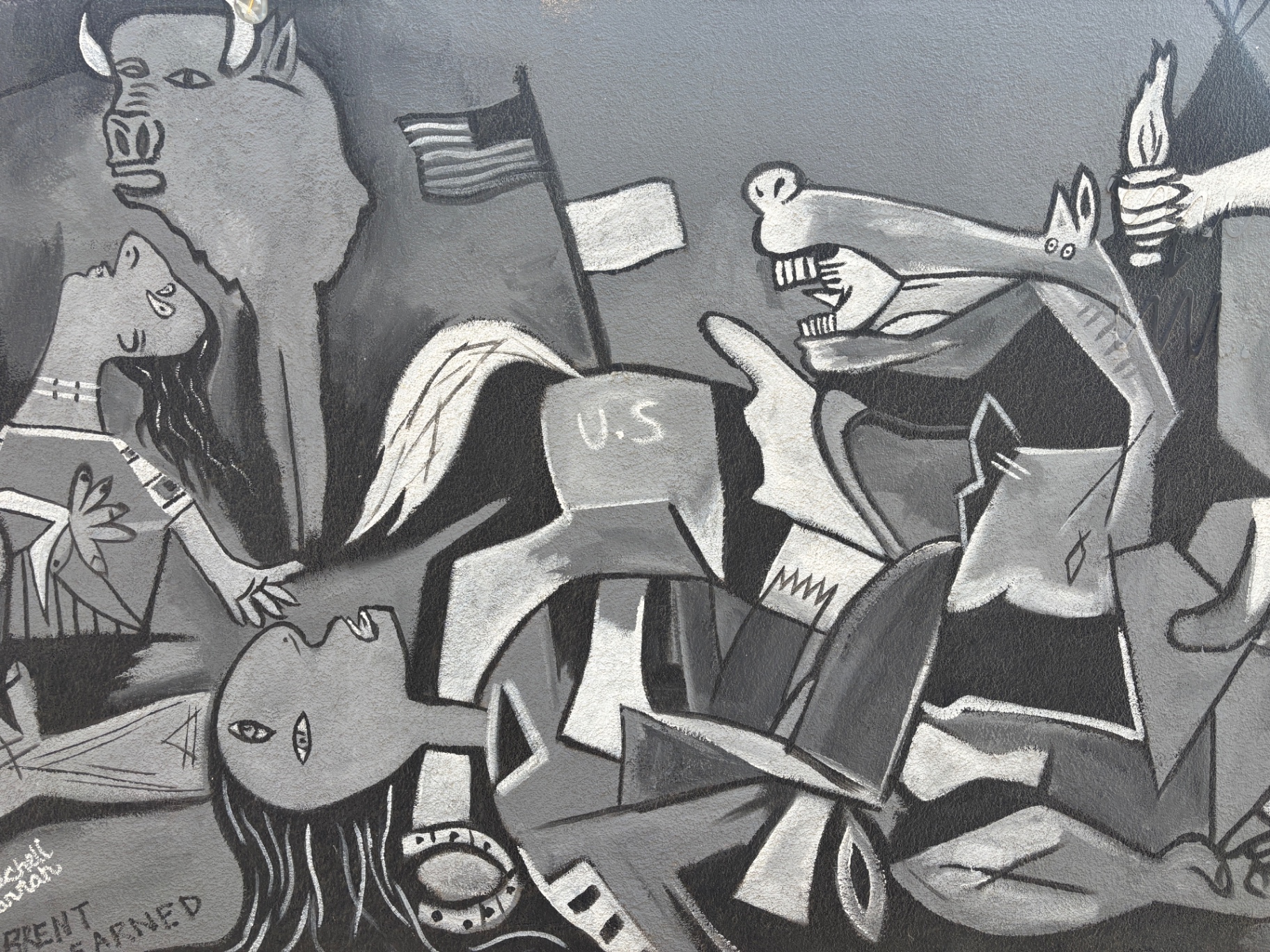
Learned deliberately departed from his signature expressionistic, hyper-vibrant color palette to deliver a stark, high-contrast black-and-white image designed to directly confront the viewer. Echoing the cubist weight and historical gravity of Picasso's Guernica, the mural documents the tragic November 29, 1864 attack by the Colorado Volunteer Militia on a peaceful Cheyenne and Arapaho encampment. As a direct descendant of Sand Creek Massacre survivors, Learned executed this public art installation to honor an ancestral promise made to his mother, Juanita Learned — the historic first woman elected to chair the Cheyenne and Arapaho Tribes.
In the artist's words
“I feel that when I paint, I'm giving a voice to our ancestors because they didn't really have one.”
“Mom and Dad always instilled in my brothers and sisters and I that you need to know where you came from in life to know where you're going.”
More from the Artist: @brentlearned
Source: Vicky Dorvee, Left Hand Valley Courier
“Arapaho Family”
George Curtis Levi
Cheyenne and Arapaho Tribes
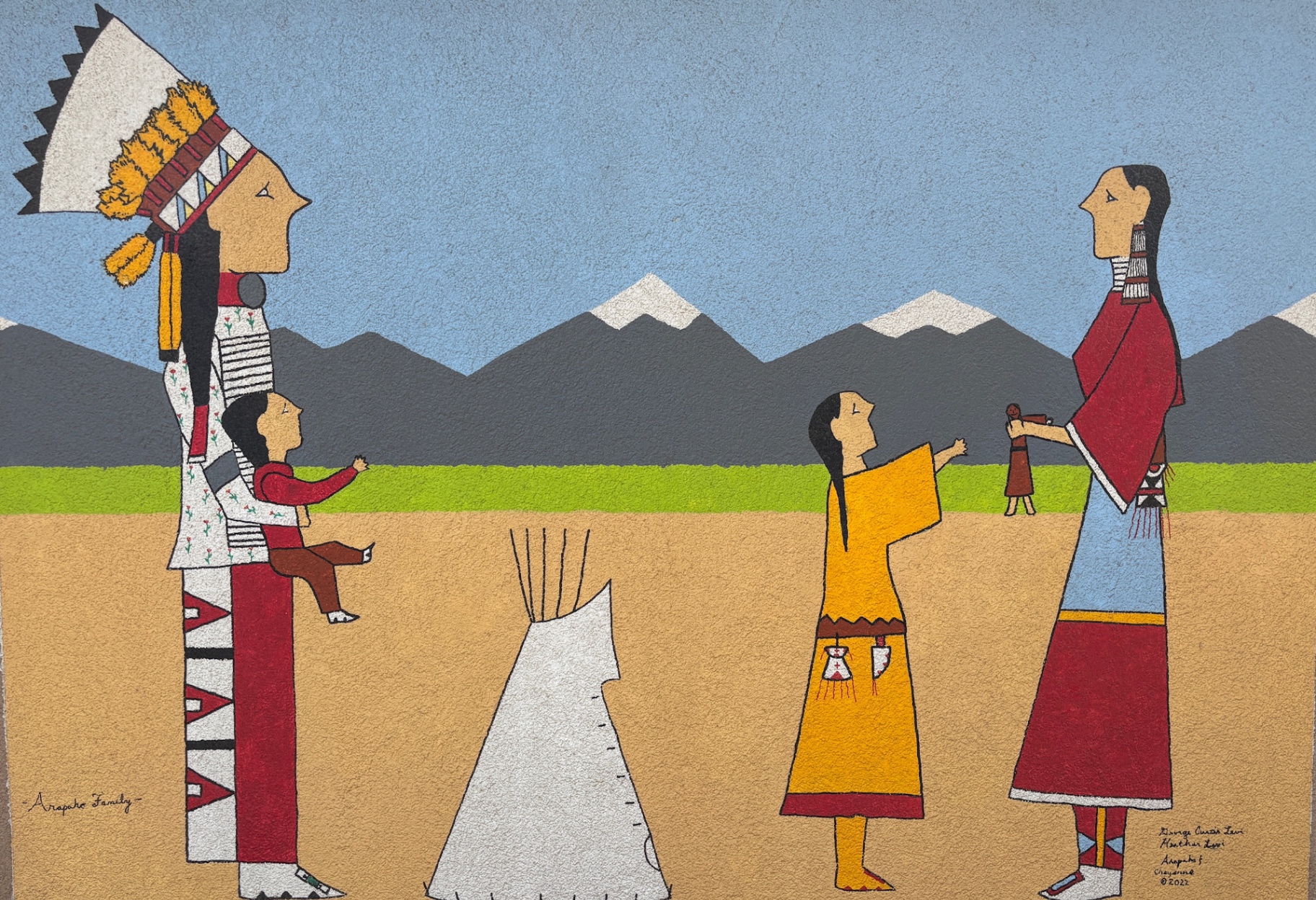
Levi concluded the public art corridor with an intricate, 8-by-8-foot fine-line ledger art style painting in the eastern breezeway. The piece illustrates a core Arapaho family looking westward toward the foothills, adorned in clothing authentic to the 1860s — the exact era their sovereign nation was forced from the Boulder Valley ecosystem. Every detailed textile design and shield glyph carries strict historical meaning. Levi, who is a cousin to fellow muralist Brent Learned, cross-referenced 1840s ledger archives for absolute accuracy, describing the installation as a formal homecoming to the exact lands where his ancestors' history resides.
In the artist's words
“The Blue Sky people, known as the Arapaho now, are still here and we're thriving. We're still carrying on the languages, the customs. And… no matter what happened to us back then, we are still here.”
“Everything about that piece is about my people. As Arapaho people, they lived and died out on the high plains into the foothills. That area, the Boulder area, is called 'Where the buffalo went up the mountain' in Arapaho.”
More from the Artist: @georgecurtislevi
Source: Vicky Dorvee, Left Hand Valley Courier
Frequently Asked Questions
The Cottonwood Square Murals are a 2022 public art installation in Niwot, Colorado featuring four large-scale works by Native artists Danielle SeeWalker, JayCee Beyale, Brent Learned, and George Curtis Levi that address the legacy of the 1864 Sand Creek Massacre and honor the visual lineage of Chief Nowoo3.
The murals are installed on the exterior walls of Cottonwood Square in downtown Niwot, Colorado, and are free to view at any time.
This effort was supported by funding from the Niwot Local Improvement District, the NBA, and the Niwot Cultural Arts Association.
The murals restore authentic Indigenous historical truth-telling to the built environment of Niwot and support Native and Indigenous art in the Niwot, named after Southern Arapaho Chief Nowoo3 ("Niwot," Left Hand).
The murals are self-guided and visible year-round.