Building Arapaho, Cheyenne and Niwot Relationships
As Niwot commemorated its 150th anniversary in March 2025, we invited Arapaho and Cheyenne Tribal Elders to our community with a focus on:
- 01
Welcoming Mr. Fred Mosqueda (Southern Arapaho, Sand Creek Massacre Representative) and Mr. Chester Whiteman (Southern Cheyenne, Sand Creek Massacre Representative) to discuss how truthful historical storytelling—including Niwot’s connection to the Sand Creek Massacre—is a foundation for building relationships.
- 02
Exploring how Niwot and the broader Boulder community can build relationships with the Cheyenne and Arapaho Tribes for the next 150 years.
- 03
Honoring Southern Arapaho Chief Nowoo3 (Chief “Niwot,” or “Left Hand”)—our community’s namesake—who sought mutual understanding and respect.
Phillip Yates and other Niwot community members thank them for sharing their perspectives and guidance during this inaugural gathering on March 17, 2025. We look forward to our next community dialogue, tentatively scheduled for February 2027.
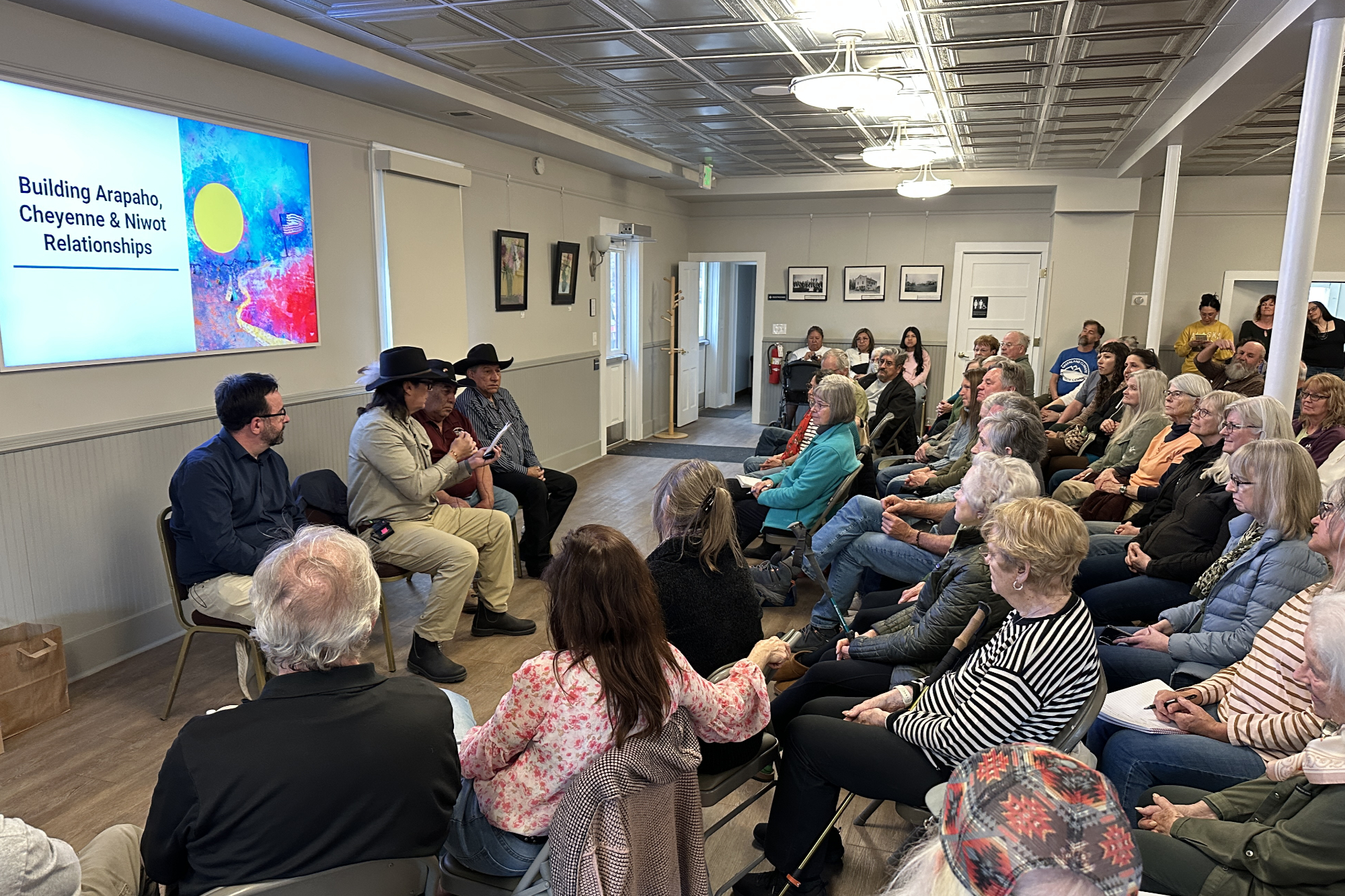
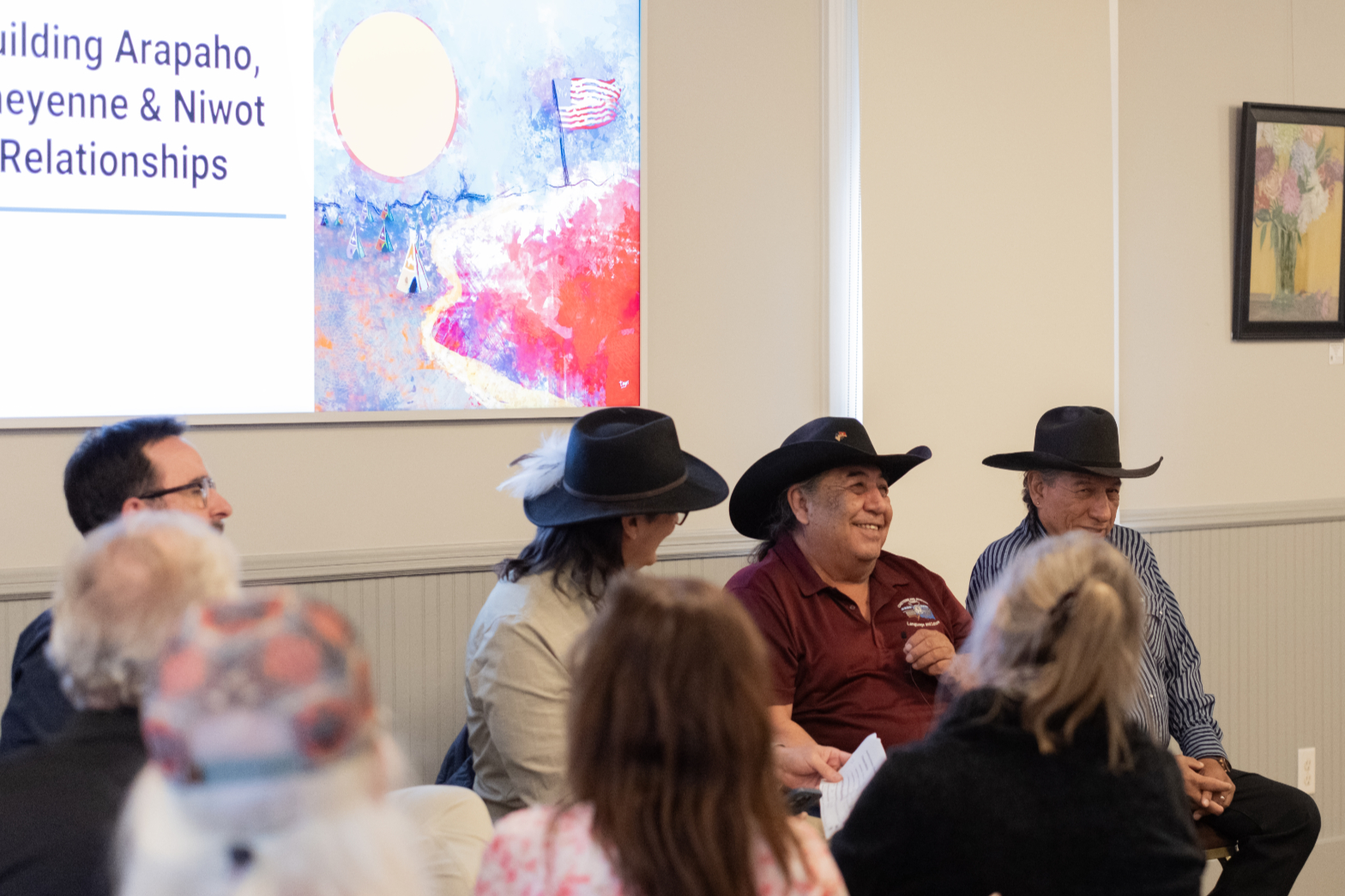
Key Guidance from Building Arapaho, Cheyenne and Niwot Relationships
Together, Mr. Mosqueda and Mr. Whiteman offered Niwot a roadmap to help move beyond land acknowledgments. Their knowledge comes from years of consulting with federal agencies and local communities, including the City of Boulder and Boulder County. The pair were also instrumental in helping to rename Mt. Evans to Mount Blue Sky.
Their guidance gives Niwot a practical path forward: sit together, learn the true history, show respect, ask what can be done together, and build relationships through action rather than symbolism.
“First of all, we need to sit down at a table and talk… Not just talk about it, not just dream about it, but to actually make it happen.”
“We don't want to come and demand anything of you. We want to come and say, 'What can we do together?' And that's what we want.”
“We try to bring our Nation and the non-Native nation to an understanding where we can get along, work together, and move forward in this day and age.”
“Once they get to know who he [Nowoo3] was, then they will begin to know who the Arapaho People were and who we are today.”
“I was always told to get respect, you have to give it… There's still a lot of open wounds out there, so we need to show respect to one another and move forward, hand in hand.”
Mr. Mosqueda provides additional guidance and personal reflections on the Sand Creek Massacre in the City of Denver’s recently released, “We Are the Land” report.
Videos from Building Arapaho, Cheyenne and Niwot Relationships
Explore these conversations with Southern Arapaho Elder Fred Mosqueda and Southern Cheyenne Elder Chester Whiteman here, or watch the complete collection on the dedicated Elder Conversations & Oral History Videos page.
Southern Arapaho Chief Nowoo3 (“Niwot” or “Left Hand”) worked tirelessly for peace alongside his siblings: his brother Neva and his older sister Mahom (Snake Woman). Tragically, both Nowoo3 and Neva died as a result of the 1864 Sand Creek Massacre. However, Mahom successfully hid and protected her children during the atrocity, surviving the massacre and keeping her family together.
Because Mahom was married to a French-Canadian trapper named John Poisal, her family had learned to speak English. Her daughters, Margaret and Mary, used this skill to serve as crucial interpreters for the Arapaho leadership during the 1861 Fort Wise, 1865 Little Arkansas, and 1867 Medicine Lodge treaty negotiations—the very treaties that ultimately forced the removal of the Arapaho People to Oklahoma.
As Southern Arapaho Elder Fred Mosqueda noted during his March 2025 presentation in Niwot, Mahom and her daughters formed a “strong family that helped the Cheyenne and Arapaho through their interpreting of the English language during our treaty years—some of the hardest parts of our history.”
›Read Transcript
Nowoo3—Left Hand—was born, and his family was born, into Little Raven’s band, who camped in the Cherry Creek area down in Denver.
Nowoo3 grew up and learned to camp here, and basically to love this area of Boulder Valley. His family had an older sister by the name of—they call her Mahom, Snake Woman. In Arapaho, she was called Shi-shi-his, Snake Woman.
She married a French-Canadian trapper by the name of John Poisal. The key to that is that John Poisal taught the family how to speak English.
And as they grew up, Left Hand—which Nowoo3 means “this side,” because he was left-handed. There were no left-handed Arapahos. They were all taught to be right-handed. But somehow he maintained the left hand, so he became known as the left side. That’s the side that he was predominantly in.
He had another brother named Neva. And these men were extraordinary humans because they were picked to be chiefs. Once they became chiefs, then he would move away from Little Raven’s band and begin to take care of his family band.
Even though, as much as he did, he was the main interpreter for Little Raven at the 1851 treaty, you don’t see his name anywhere. You don’t see him signing the treaty, because he was that kind of leader who stepped back away, but still was there to take care of the people.
He died in 1864 because of Sand Creek. Neva died because of Sand Creek. All of the family died.
How did Mahom, Snake Woman, keep her family together? Because when she was married to John, she lived in Denver. After John passed away, she moved back with her brother and became part of that band.
They said that she used to say—because her children were a little bit lighter—she always said, “They’re the first ones they’re going to kill.” So she always hid them when other tribes came in. Whatever happened, she would hide them to protect them.
She must have done a good job because she got her entire family out of the Sand Creek Massacre.
Her oldest daughter, Margaret, married Fitzpatrick, who became the first Indian agent for the Cheyenne and Arapaho Tribes. After his death, she continued to become an interpreter for the Cheyenne and Arapaho Tribes. She and her younger sister continued to interpret throughout our treaty years.
So they were present for the rest of the treaties—from 1861, 1865, 1867. They made it all the way to Oklahoma.
Mahom is buried on the side of I-40 in a white man’s cemetery. The sad part about it is that the white man became the executor of her estate and ended up taking all her land. And all she asked was that she could be buried there. So at least he honored that.
Interstate 40 comes out of Oklahoma City going straight west. Then all of a sudden it veers off a little bit, comes back, and then goes on straight west. They did not know where she was buried, so they moved the road around her so they could go on. But she’s buried there.
And this was a strong family that helped the Cheyenne and Arapaho through their interpreting of the English language during our treaty years—some of the hardest parts of our history.
Mr. Mosqueda and Mr. Chester Whiteman reflected on the Sand Creek Massacre and how the Boulder community falsely portrayed the Nov. 29, 1864, massacre as an “Indian Uprising.” A Niwot town founder was a member of Company D, Third Regiment, that assembled at Fort Chambers in August 1864 following Gov. John Evans’ proclamations and participated in the killing of 10 Cheyenne People in northeast Colorado on Oct. 10, 1864. The company later participated in the Sand Creek Massacre on Nov. 29, 1864. Chief Nowoo3/Niwot/Left Hand died of injuries from the massacre.
In the video, the Elders recount how Cheyenne and Arapaho leaders were denied the opportunity to negotiate peace before the unprovoked military attack. Emphasizing their enduring resilience, Whiteman said, “They tried to wipe out the buffalo. They’re still here. We persevere. We’re still Cheyenne people today.”
›Read Transcript
Chester Whiteman: [They went] to Governor Evans and Chivington to discuss peace, and they weren’t allowed to do that — to come up with peace.
So the governor and Chivington turned the Cheyenne and Arapaho people over to Major Wynkoop. They told him that he could give them rations and take them down to where they needed to go, and that was to Sand Creek. And Sand Creek has no water, no game, nothing. It’s just barren country.
Once they got there — they went through Bent’s Fort, and there was Fort Lyon down the roadways — and once they got there, Wynkoop was getting to be too friendly with the Cheyenne and Arapaho people. So they took him out of that position and put Major Anthony in.
Major Anthony was one of Governor Evans’ people. It seems like all the officers that were in that 100-day department had a plan before, and it wasn’t to go after the Indians. It was to remove them from this place, because all of them had a title. One was a timberman, one was a banker, one was real estate, and it goes on and on. They were railroad people. So they wanted that railroad to come through, but we were in the way.
So when they attacked this — I’m going to say it was a retirement camp, because there were very few warriors there. There were elderly chiefs, knowledgeable people, women and children. So when they attacked that village, they took out half of our leadership.
Our chiefs have a band of 44. That’s how many chiefs we have in the Cheyenne organization, or the tribe. And they took out over half of our leadership in one day.
And after that, Black Kettle survived, and he made it out. Left Hand got hit, and he made it to a Sioux camp that was there. They tried to help him, but he didn’t make it. So there are a lot of things like that that nobody hears about.
And after they brought all the mutilated parts to parade through Denver, then after Captain Soule gave testimony — and Cramer — well, both of them were killed. They were assassinated on the streets. So Chivington was never punished for that.
Prior to all this that happened was the Doctrine of Discovery. They thought we didn’t know anything about religion, but we had our own way of what you might call today religious freedom. And we still use it today.
And once that Doctrine of Discovery came, well, that Doctrine of Discovery said: if they’re not Christian, kill them and take their belongings. Even though we knew how to pray, and we had a higher power that we talked to.
Then came along Manifest Destiny. That’s where we really got beat up pretty good. And today, we’re still feeling the effects.
Sand Creek — the document, the Treaty of 1865, Article Six — said that everybody should get reparations. Cheyenne and Arapaho people should get reparations.
When they moved us to Oklahoma, they got us out of Colorado. They moved us to the western half of Oklahoma. At the time, we had about 8 million acres. So they said, ‘Let’s make a deal with you guys. We’ll give you each 160 acres apiece.’ So besides giving us 160 acres apiece, then they took the rest, which was about 5 to 7 million acres, and opened it up to whoever wanted it.
So we’ve been, I’m going to say, crapped on for a lot of years. But we’re still here. They tried to wipe out the buffalo. They’re still here. We persevere. We’re still Cheyenne people today.
Fred Mosqueda: Like you said, the 1851 treaty gave us this portion of this land — this plains area, the Front Range. We didn’t understand ownership. And, as you know, the churches said, if you don’t do something with the land, then you don’t have a right to own it.
They didn’t understand that the land took care of us. Everything we needed — the medicines, the food, all the things that we used — was provided by this land.
So we knew — again, Nowoo3, he understood English. So he understood the 1851 treaty said they’re not supposed to stay here. They can pass through, but they’re not supposed to stay here.
So this is why he’s been recorded as saying, ‘You can’t stay here.’ But being Arapaho, he said, ‘They’re going to starve to death if you don’t help them.’ So he said, ‘Okay, you can wait till spring.’
So this was the attitude of the Cheyenne tribes. They knew that they weren’t supposed to stay here. So they never really were — the Arapahos were never at war at all. But the thing about it is that they understood this, and they talked to the people in Denver. They knew who Little Raven was. They knew who these chiefs were. They knew who Left Hand was.
And then they began to create this story. They began to create, using the newspapers and other ways of communication, that there was an uprising. This uprising never existed. But they had to use something as a way to remove us.
So this was the story that they created here, and it was done very, very well. It was done so well that when the marker at Fort Chambers was created, it still said ‘uprising.’ After all these years, it still said ‘uprising.’
They believed that we never came back to this area after 1861. So this story couldn’t exist because we weren’t here. We were over there, in the plains area down below.
So this is the thing that always disturbs me so much: this undertaking of telling this falsehood on the Cheyenne and Arapaho Tribes, when all we wanted to do was live in peace.
These chiefs went out of their way. They even brought hostages so they could help ransom people who were held for ransom. They used them to show that, in their hearts, they were true to this peace faction.
Left Hand, Black Kettle, White Antelope — all these were great warriors. They cut their teeth on the Pawnees, the Utes, the Osages. They were known to be warriors. But yet they came forward.
So that’s the part that really disturbs me: the falsehood that was made believable here in the Boulder Valley.
Somewhere along the line, did you ever all think about why Major Wynkoop, and why Silas Soule and Cramer, all of a sudden figured out: wait a minute, these guys are humans? Before that, we were not considered humans. And what happened to them when they stood up for us? One was removed; the other was killed on the streets of Denver. We were humans. And they found that out.
Mr. Mosqueda and Mr. Whiteman shared their experiences and perspectives on relationship-building with local governments, nonprofits and other organizations, including with the City of Boulder, Boulder County, the state of Colorado, and federal agencies over the past several years.
In the video, the Elders explain that replacing comfortable “Hollywood history” with truthful storytelling is the only way to foster genuine reconciliation. Emphasizing that this ongoing work requires mutual effort and respect, Whiteman notes, “It takes both sides to heal. So you have to do it together. And that’s kind of where we’re at. We try to bring our Nation and the non-Native nation to an understanding where we can get along, work together, and move forward in this day and age.”
›Read Transcript
Chester Whiteman: We’ve been up here a few times. We almost live here anymore.
When we first started out, we were getting a little static. There were still feelings that weren’t good between the Natives and the non-Natives. There were some bad stories out there accusing the Natives of starting a war — different things like that — and that wasn’t true.
I call those stories “Hollywood history,” because folks tend to spin a story that benefits them, and they stay away from the truth.
And when Fred and I took these positions, we said, ‘We’re going after the truth, brother.’
So from that time on, we’ve been talking with different communities. And they say, ‘What do you need?’ And they say, ‘Well, we need healing.’ But healing is just not one side. It takes both sides to heal.
So we try our best to get that point across, to where everybody’s happy — not just one side or the other — because if one side is healed, then the other one’s still hurt. So you have to do it together.
And that’s kind of where we’re at. We try to bring our Nation and the non-Native nation to an understanding where we can get along, work together, and move forward in this day and age.
Today is getting ridiculous. I’m telling you, it is ridiculous today. And there’s no need for that. It’s crazy, but we still have to deal with it. It’s not a bad dream. It’s for real.
And we want to continue to work with all the communities up here in Colorado to build a strong relationship with them, so we can move back up here to our land. So with that, I want to pass it back to our brother.
Fred Mosqueda: As he said, when we first came here, we came as an unknown. You had history books that said who we were in their written history. So when we got here, that’s what you expected of us.
But as we began to educate — and we knew we had to do this — on who we were, our feelings, how we used to be here, how we lived here, what happened to us. We didn’t want to come up here and glare at you and say, ‘You did this to me,’ and all this. But we wanted to educate you.
And we began to do that. We began to tell the stories. We began to tell our side of the history.
Even though, in some places, they did still tell us, ‘Well, we’re tired of hearing about that.’ Well, then we begin to say, ‘Well, then you tell me about your history. Tell me what your family did that was here.’
And so that way, we begin to share each other’s feelings, each other’s history. And we begin to talk to different communities, and we began to tell them that we wanted them to understand us.
And this way, when the healing process starts, we can lean on each other to take care of it. And then we can make this place, as beautiful as it is, even more homey.
Mr. Mosqueda and Mr. Whiteman discuss how communities can move beyond land acknowledgments by engaging with Tribal Nations—bringing them to the table and recognizing the unique knowledge and contributions Tribal communities offer.
In the video, the Elders explain that moving past passive statements requires tangible, face-to-face collaboration that benefits both the local community and the sovereign Nations. Highlighting the real-world opportunities for shared success, Mosqueda challenges the community to take action: “We can both be successful by using what each other can bring to the table. But let’s bring it to the table, and that’s where we can start.”
›Read Transcript
Chester Whiteman: First of all, we need to sit down at a table and talk.
Some of these properties that we talked about in the 1860s — they were already taken before the government gave us, or put pen to paper, at Fort Wise. Those properties belonged to Cheyenne and Arapaho people, but that was overlooked.
All these treaties said, ‘Well, the government’s going to take care of you. The government’s going to take care of you.’ But who was watching the government? Who was supposed to be taking care of us, watching over us? Who was supposed to enforce those regulations? There was no oversight.
And we want to get away from that. We want to sit down and talk things through here so we can all benefit from what we accomplish and put together here. We don’t want one side over here and one side over here. We want to sit at the same table and talk this thing through and make something positive happen for this valley, this part of the state — and cause it to really happen.
Not just talk about it, not just dream about it, but to actually make it happen.
Fred Mosqueda: I agree 100% with my brother.
You have to sit down and talk to us, and basically look at what we can do for you, because we as a Tribe have special status when it comes to the government. If we put it in trust status, it becomes tax-free.
But we also have other status that, when we do go into a business, gives us better opportunities for success.
We didn’t know these things a long time ago, and we didn’t like treaties. But then we began to read them, and we began to say, ‘Wait a minute, these are not too bad. They do have things in there.’
And again, if you will look at your business side, look at us. What can we offer you with our status?
We can both be successful by using what each other can bring to the table. But let’s bring it to the table, and that’s where we can start.
Mr. Mosqueda and Mr. Whiteman reflect on opportunities for co-stewardship of lands with Colorado communities, including efforts to bring buffalo back to Boulder County, and discuss the Cheyenne and Arapaho Tribes’ recent resolution expressing their desire to return to the state.
Emphasizing that this homecoming must be collaborative, Whiteman notes, “We want to continue to work with all the communities up here in Colorado to build a strong relationship with them, so we can move back up here to our land.” Echoing this cooperative vision, Mosqueda makes it clear that the Tribes are not returning to make demands, but rather to focus on shared possibilities, captured perfectly in his meaningful question: “We don’t want to come and demand anything of you. We want to come and say, ‘What can we do together?’”
›Read Transcript
Fred Mosqueda: When it first started out, we were here. We started coming to educate people and to tell them who we were — that we were still alive, but we live in Oklahoma now. Not by choice, but we live there, and we’re doing very well.
We are the largest Tribe in western Oklahoma. They treat us elders, seniors — they treat us pretty good.
And if you get a chance to see our governor, he’s very business-minded. The lieutenant governor before this was also very business-minded, but he knew oil and gas.
Then we got into gaming, and now we’re starting to create our own enterprises. We have a buffalo ranch. We also have a ranch in western Oklahoma.
So we’re doing a lot of things there in Oklahoma, but we also passed a resolution stating that we’re ready to come back and be part of Colorado. [Applause]
But we don’t want to come back and say, ‘All right, we want your land, your land, your land, your land, because you owe us.’ We don’t want that.
As Rick Williams is well-versed in saying, the government has tons and tons of reserve land that they’re not using. Why not start there?
Why not — as we’re doing with Boulder, Boulder County — let’s work together. We’re actually doing a co-stewardship that we’re trying to bring buffalo back into Boulder County. [Applause] So we’re looking at that.
Again, Chester and I, we always look at how we can help the schools. Down in Littleton, they changed one of the school names to Little Raven. Well, we put a display there that has an actual copy of his shield and some other things, and the stories about the man, Little Raven.
We always work with education, but we’re also looking at what other things we can do here.
Because we don’t want to come and demand anything of you. We want to come and say, ‘What can we do together?’ And that’s what we want.
Mr. Fred Mosqueda and Mr. Chester Whiteman of the Cheyenne and Arapaho Tribes discuss how they collaborated to rename Mount Evans to Mount Blue Sky in Colorado. The mountain was originally named after former Gov. John Evans, who helped set the stage for the Sand Creek Massacre.
In the video, the Elders recount the long, often contentious process of uniting sovereign Nations and government agencies to finally enact this historic change. Whiteman explains the profound, unifying meaning behind their chosen name, recalling the moment they agreed on it: “I said, ‘Blue Sky.’ I said, ‘It covers the Arapaho, covers the Cheyenne.’” Echoing this desire for collective healing, Mosqueda adds, “The thing is that we didn’t want a name that would be hurtful. We wanted something that would be strong from the heart, that covered both of our people.”
Reflecting on their arduous journey from Oklahoma all the way to the 14,000-foot summit to sing a victory song, Mosqueda proudly notes, “I looked at my brother and I said, ‘Two little nobodies from little bitty towns have done something on a national level.’”
›Read Transcript
Chester Whiteman: We were at home, and brother came in the office. He said, ‘Hey, they’re trying to name this mountain.’ They already had, I don’t know, three or four names already. He said, ‘Do you think we can come up with a name?’
And we were in the dungeon — they put us in the building, a historical building where they used to do business for Tribal members. So they had us in the bottom, to keep us out of sight.
And he said, ‘Hey, we need to try to come up with a name.’ And I was sitting there thinking. He walked out, and he came back. I said, ‘Blue Sky.’ I said, ‘It covers the Arapaho, covers the Cheyenne.’ He said, ‘Yeah, let’s go for it.’
So we went and put it on paper. Then we started — nobody said anything. We started bumping heads with everybody. ‘Well, it needs to be this. It needs to be this.’ ‘No, we’re going to stick with this name.’
So we had arguments for, I don’t know, a lot of arguments. And then the ones who were squabbling with us, we got on a Zoom meeting and we told them the history — where these names came from and where they belonged.
Pretty soon they quit talking to us, and then Blue Sky came out on top. [Applause] Folks listened to us.
Fred Mosqueda: The thing that always strikes me is when this started, a bad thing happened, and it changed the way the country looked at everything. And so this opportunity came because of something that happened bad, and it turned around to be good.
The thing is that we didn’t want a name that would be hurtful. We wanted something that would be strong from the heart, that covered both of our people.
You see Cheyenne and Arapaho Tribes — that’s one Nation in the eyes of the government. That is two completely separate people. And that’s how me and my brother work. We work that way.
And it wasn’t quite like that. I was already out of his office, and he hollered across the hall, ‘Blue Sky.’ And I thought, ‘What’s wrong with him now?’ I went back over there and I said, ‘What?’ He said, ‘Blue Sky.’ He said, ‘It takes care of you, and it takes care of us.’ So he said, ‘Hey, that’ll work.’
So Paul Stitler of the Wilderness Society, who’s a lawyer, contacted me and he said, ‘We need to change the name of that mountain.’ And I agreed with him 100% right off.
We didn’t know how to do it. So we went the only way we knew, which is that we are considered a sovereign Nation. We work with the government, government to government, on these things.
So we went and we campaigned first. We went to the chiefs. We brought the chiefs, and we fed them and talked to them and asked them, ‘What about this name?’ They said, ‘Yes, good. Good name.’
So he went to his chiefs, and I went to my chiefs. We got them to agree. So we wrote that up, and we got all the support. Then we went to some of the ceremonial leaders, and we talked to them. ‘Yes, great name. Go for it.’
We did all this, and then we went to our legislators and said, ‘Can you pass us a resolution, and we’ll send it to Congress, because Congress has to change this?’ Right? We didn’t know.
So we did that, and Paul Stitler saw it and said, ‘Let me talk to you. This is not how you do this.’ So he talked to us, and he led us, and he co-sponsored that application with us. And that was the beginning of it.
And then we began — okay, we went to our Tribes, our brothers up north, and we talked to them. After that, we began to have meetings, and we began to invite the public. There were, like, two pages long of support by the time this got to the naming board in D.C.
So we had tons and tons of support, but we also had some tough times where we had to argue and talk to people about, ‘Wait a minute.’ There was a lot. We even talked to Governor Evans’ relatives. We even talked to his great-granddaughter, and I still keep in touch. We got a Christmas card from Carolyn that still remembered us from that time.
So I think it built the country together — this name and what we did.
And when it was done, I made a mistake. I always open my mouth and say the wrong things. I was in the middle of trying to convince everybody that this is a great name and we should do it, and I said, ‘When it’s named, I’m going to go to the top of that mountain. I’m going to sing a victory song.’
I had no idea what 14,000 feet was. Fourteen-two is up there. And we went at sunrise, and it’s cold, and the wind is blowing 60 miles an hour. And I’m sitting in the van saying, ‘Why did I do this? Why couldn’t I just be satisfied with the name?’
Thank God my grandson was there, and Clarenda was there. They were running around like it was nothing. I’m staggering toward where we were trying to get a little break from the wind, but we got it done.
So after we got done, I looked at my brother and I said, ‘Two little nobodies from little bitty towns have done something on a national level.’
Mr. Mosqueda and Mr. Whiteman discuss the profound depth of Traditional Ecological Knowledge and how their ancestors’ understanding of the environment remains vital today. In the video, the Elders explain how their people have always worked with the natural elements, noting that many modern medicines—such as aspirin from willow trees—originated directly from Native practices.
Emphasizing this enduring, intimate connection to the land and its resources, Whiteman points out, “We still know how to use these plants and different things to help our people. And we know how to work with the elements.” Echoing this reliance on the natural world to navigate modern challenges, Mosqueda explains how closely observing shifting animal behaviors and plant cycles helps them survive a warming planet: “The world changes, and we adjust to it. Yes, it’s very, very interesting that you should bring it up, because we’re adjusting to the climate change by watching the plants and the animals.”
›Read Transcript
Chester Whiteman: But we have ways of doing things that go back in time, to take care of things like this. It was already in place before they started doing all this other stuff. So we’re well aware of the ecosystem.
If you look at the plants and everything — willow comes aspirin. This coneflower is Novocain. Different plants, they’re in the non-Native pharmacies now. That came from us, but you’re not going to hear that anyplace.
We still know how to use these plants and different things to help our people. And we know how to work with the elements.
So we try to do that with non-Natives, but we have to put the non-Native first, because when a Native goes forward, there are two strikes on them. So we want somebody to kick the door down so we can get inside and do our thing.
[Unidentified speaker: The allies.] Yeah. So we’re still trying. I mean, we’re not going to quit.
Fred Mosqueda: I think the interesting part is what you asked. We’re always concerned with water. We’re always looking at water. How can we keep our water so that we can use it?
But as he said, we watch the plants, and they begin to tell us something. How they’re growing. Our animals are doing the same thing.
He noticed the other day the buffalo are now calving out of season because of that. He said that if this was the old times, they would have never made it through the winter. But now, because they’re calving, and because of how warm it is, and how everything buds out sooner, they’re able to survive.
So the world changes, and we adjust to it.
Yes, it’s very, very interesting that you should bring it up, because we’re adjusting to the climate change by watching the plants and the animals. Thank you.
Mr. Mosqueda and Mr. Whiteman discuss the critical importance of preserving the Arapaho and Cheyenne languages and the ongoing efforts to teach them to new generations. In the video, the Elders examine how modern tools like smartphone apps and CDs are being used to save their languages, but stress that true fluency cannot be learned simply from a textbook or rote memorization.
Emphasizing that these are oral traditions meant to be shared in community, Whiteman explains, “Our language is a living language. So it needs to be taught that way—face to face, or carried on in a conversation.” Echoing this sentiment and highlighting the profound spiritual necessity of keeping their native dialects alive, Mosqueda adds, “The songs and the ceremonies that we do just mean more when they’re done in our language. They always told us—the old ones up there always told us—our pipe loves to hear the Arapaho language.”
›Read Transcript
Chester Whiteman: We have a language department that we’re a part of, and we have people that are teaching. We have — I’m going to say students — that are trying to teach. And we’ve been telling them, ‘You need to get the fluent speakers to do conversational language. That’s the only way you’re going to understand it.’
It’s not ABC, or red, white, and blue. You have to talk every day, back and forth, to understand the language and the phrases and everything like that. But what do we know?
So they don’t listen to us. But they have CDs and stuff like that, with different things on them — Arapaho CDs and Cheyenne CDs. So if you give me your address, I’ll send you some. There’s a beginner and intermediate and something else on there. I don’t know. I just look at the labels.
And there’s also an iPhone app that you can download, and an Android app, for Arapaho and Cheyenne as well.
And then there are two non-Natives that have very good Arapaho and Cheyenne, and they both teach. One is from here in the Denver area — Andy Cowell. And the other one is Wayne Leman, at Dull Knife College in Lame Deer, Montana. And they’re very good. They talk good Cheyenne. They talk good Arapaho.
Like the teachers that we have right now, or that are trying to teach, their words are like plastic. They’re saying the right syllables, but it’s not coming out right.
Our language is a living language. So it needs to be taught that way — face to face, or carried on in a conversation. Not, ‘Well, this is how you say this, and this is how you spell it.’
My grandmother, she’s very fluent in Cheyenne. She said, ‘I don’t know how to spell these words.’ She said, ‘I wasn’t taught that. I just spoke face to face with the old folks back in the day.’
So, I don’t know. Hopefully we’ll get it back running like it’s supposed to. May need to change a plug or two.
Fred Mosqueda: Like you said, there are apps you can get on the Cheyenne and Arapaho website, and you can see that. I don’t know whether Andy has anything here.
But again, like my brother was saying — and he knows the difference, too, because of the distance and the time separation between our Tribes — the Northern Arapahos and the Southern Arapahos, we speak the same language, except we say some things a little different.
And it’s taken a little while, because I speak the Southern Arapaho dialect, and we use a little bit different sound. It’s a musical, pretty language that rises and falls.
And [Butch] has finally figured out, ‘Wait a minute, there is a difference.’ So he can speak both. And if you ask him — I’ve done it. I’ve told him, ‘All right, now say something,’ and he’ll answer back in the Southern dialect. So there is a difference, but we can understand each other.
And we need — I really push the young ones that are learning this language to continue to try to learn it. It’s a hard language, but it’s very, very meaningful.
The songs and the ceremonies that we do just mean more when they’re done in our language.
They always told us — the old ones up there always told us — our pipe loves to hear the Arapaho language. So when you get a chance and you want to pray to him, pray in the Arapaho language. Tell him what you’re needing in the Arapaho language. That’s what they always told us.
And so that’s one of the things that I know. My brother here is the same way: when we instruct on these different ceremonies, we use our language as much as we can so that they can understand. We have to, again, sometimes describe it in English. And that’s another thing: you all learning sign language — the English language replaced the sign language.
Phillip Yates and other Niwot community members thank Jason Houston and Dewi (day-wee) Sungai Marquis-Houston with Eight16Creative for their videos of the event.
Before the Event: Walking the Land Together
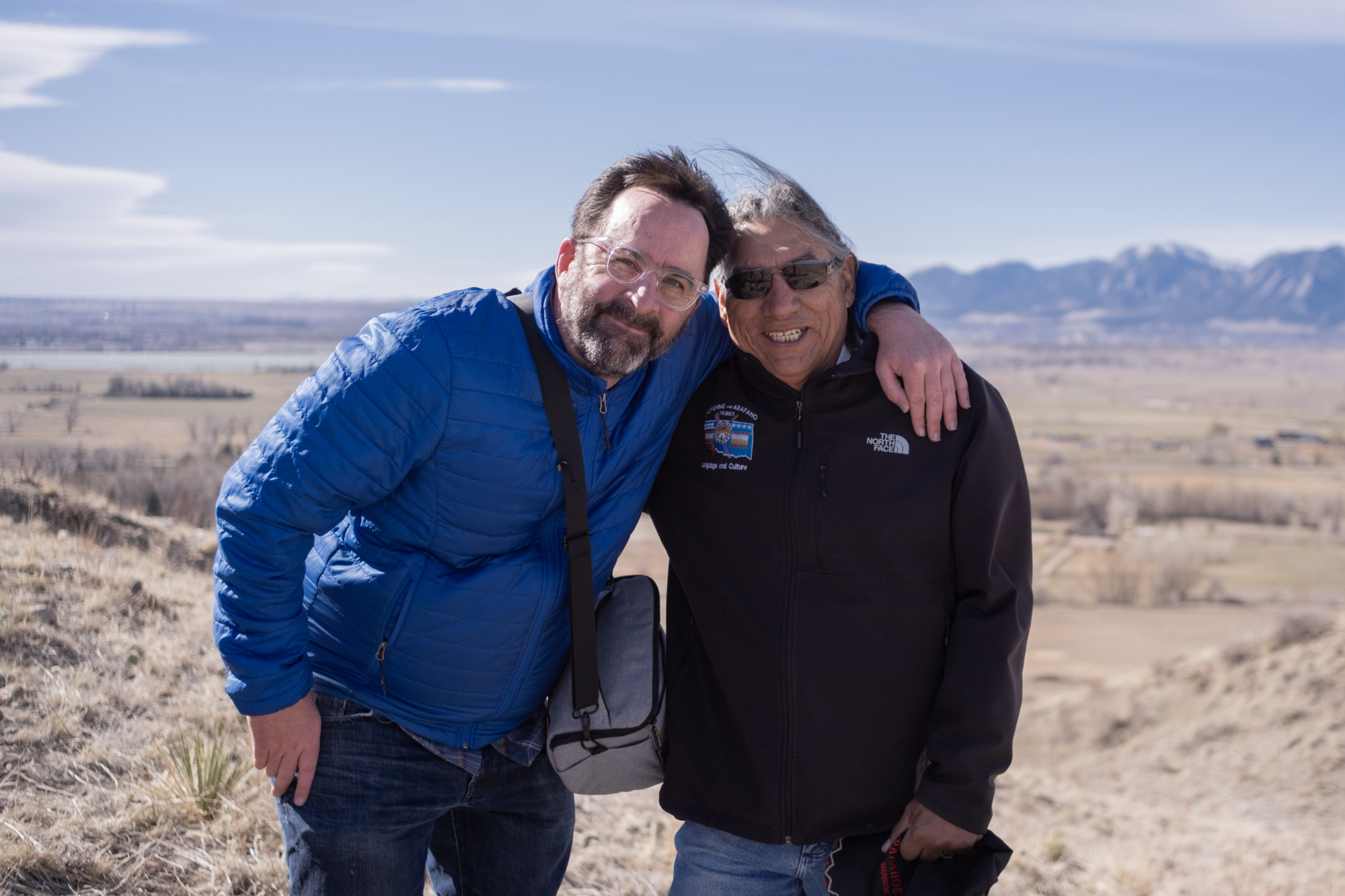
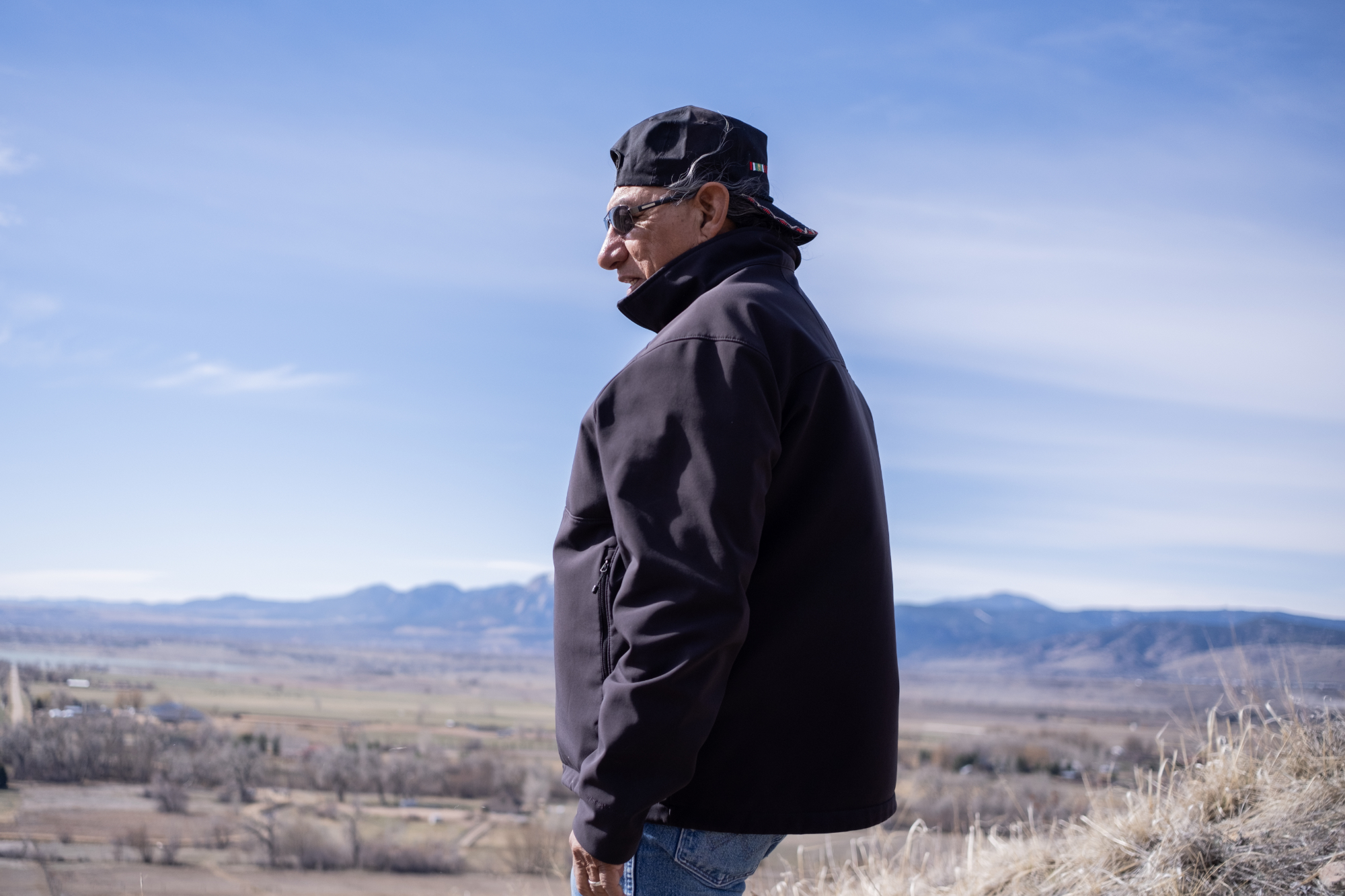
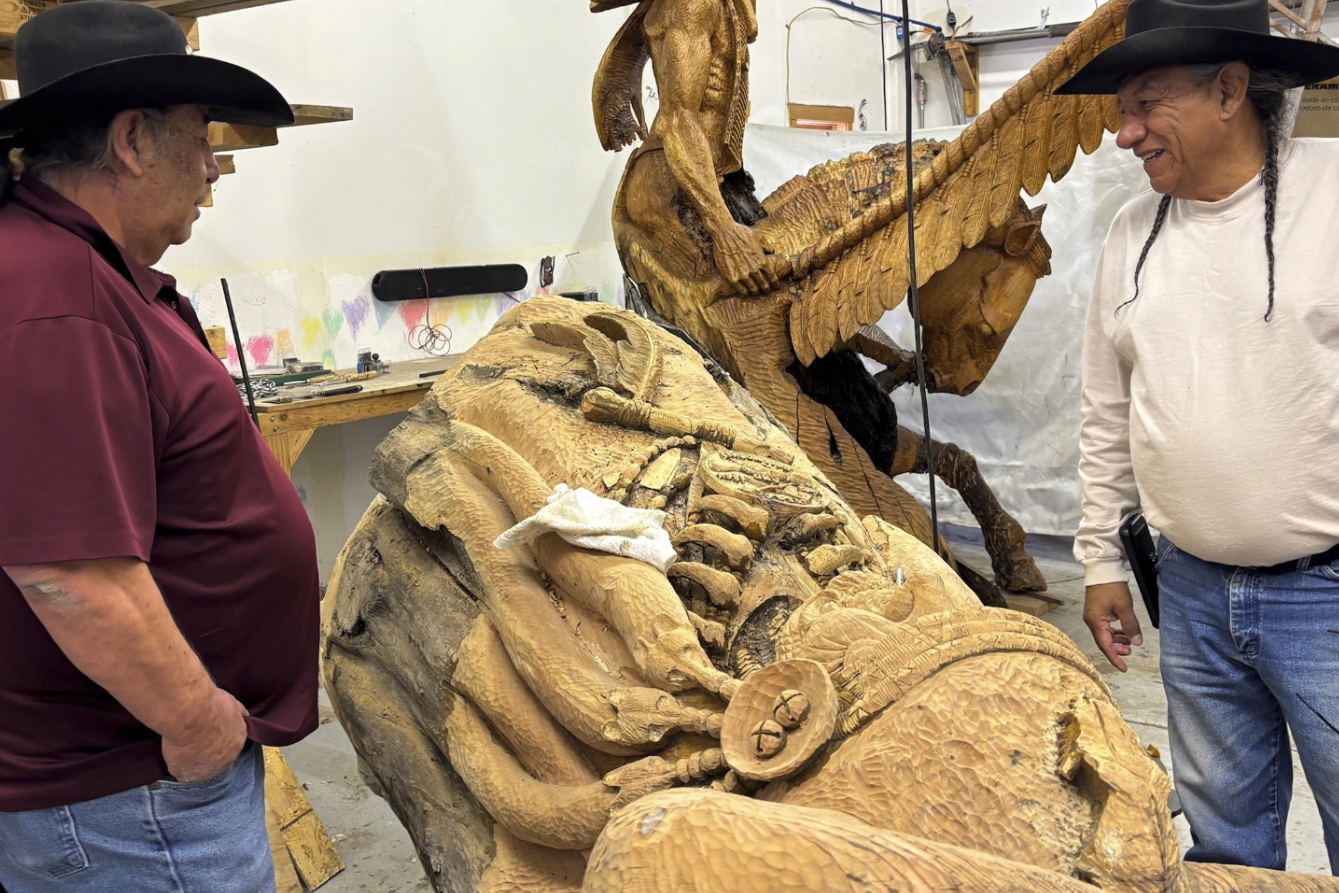
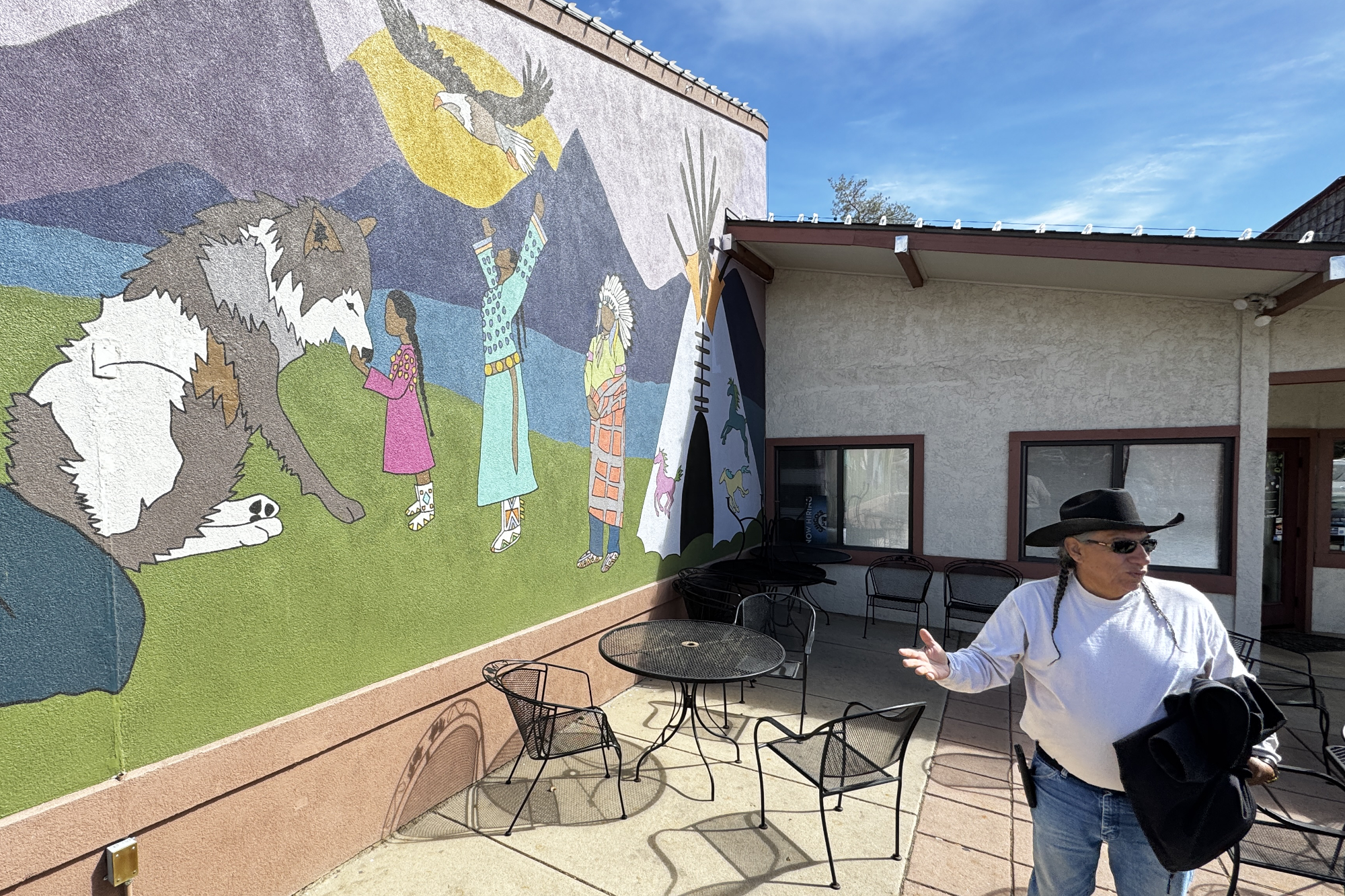
Before taking the stage, Mr. Mosqueda—who previously spoke in Niwot—and Mr. Whiteman connected with the community by touring the Native murals and wood carvings in Cottonwood Square and by hiking Haystack Mountain, recently purchased by Boulder County Parks and Open Space. For those who participated, the hike offered profoundly special moments: it marked the first time an Arapaho Elder had returned to this important site in 166 years, a meaningful moment that was honored by the sight of an elk herd walking through the valley below.
A Powerful Visual Metaphor: Gratitude to Tom Myer
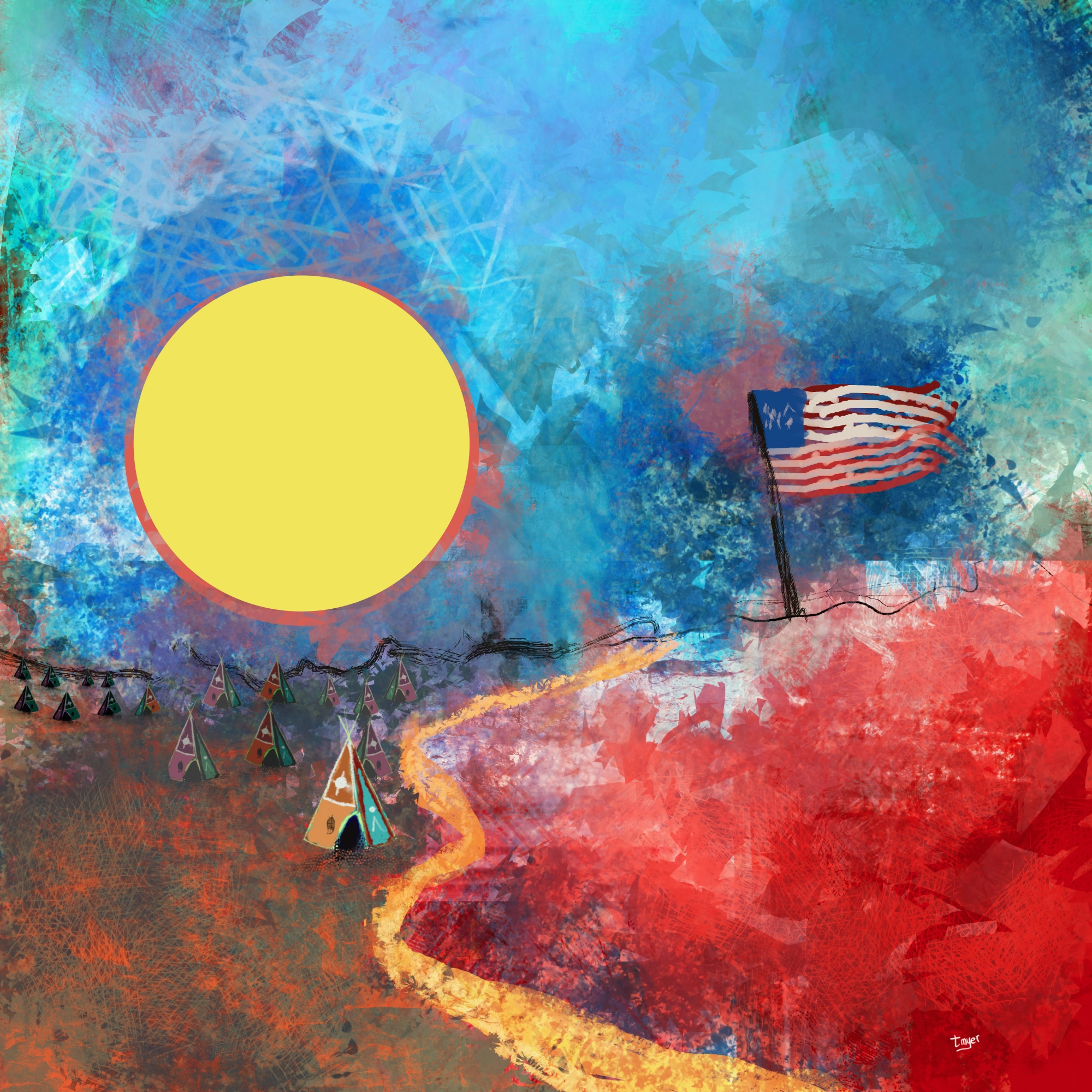
Deep thanks to local Native artist Tom Myer for his strategic vision and support in planning “Building Arapaho, Cheyenne, and Niwot Relationships.” In addition to generously stepping forward to moderate the community dialogue, Tom provided his evocative artwork, Encroachment, to serve as the event’s core visual metaphor. The piece powerfully reflects the historical realities of white colonization in Colorado and the continuing legacy of the 1864 Sand Creek Massacre.
The Path to Building Arapaho, Cheyenne and Niwot Relationships
Initial efforts to foster relationships between Niwot and the Cheyenne and Arapaho Tribes grew directly out of collaboration between Fred Mosqueda, Chester Whiteman, and Phillip Yates. Working alongside representatives from 16 different Tribal Nations, they focused on building meaningful regional partnerships and supporting:
- 01Creating the recently released Tribal Ethnographic Education Report, which features in-depth perspectives from Arapaho and Cheyenne Tribal Representatives.
- 02Renaming Settlers’ Park to “The Peoples’ Crossing”, marking the historic site where Chief Nowoo3 (“Niwot,” Left Hand) told gold-seekers they could not stay in 1858.
- 03Planning a community event with Tribal Elders to honor city-tribal relationships; although the initial gathering was postponed by weather, the collaborative planning process significantly deepened those partnerships.
Phillip Yates is grateful for the guidance provided by Mr. Mosqueda and Mr. Whiteman in communicating the history of Fort Chambers—the mobilization site for Company D before the Sand Creek Massacre. You can read their perspectives in the official project press releases issued in March and July of 2024.
The Principles of Authentic Consultation
Relationship-building with Tribal Nations requires care, humility, patience, and clear boundaries. This community work is informed by Phillip Yates’s experience supporting municipal Tribal engagement, including work with representatives from 16 Tribal Nations, public-history projects with the City of Boulder, and communication around The Peoples’ Crossing and Fort Chambers. That experience does not make this website a substitute for formal government-to-government consultation, nor does it authorize the site to speak for any Tribal Nation or Colorado community. Instead, it helps Niwot residents understand how local communities can move beyond passive acknowledgment and build relationships grounded in listening, respect, public education, and tangible support.
Frequently Asked Questions
This work focuses on relationships with the Cheyenne and Arapaho Tribes because Niwot is named for Southern Arapaho Chief Nowoo3, also known as Chief Niwot or Left Hand. His immediate family history, including Neva and Snake Woman, is part of the Southern Arapaho story. After the violence and forced removals of the nineteenth century, many Southern Arapaho and Southern Cheyenne people were forced from Colorado to Indian Territory, where the Cheyenne and Arapaho Tribes are now based in Oklahoma. NiwotLivingHistory.org will continue to seek respectful opportunities to include other Tribal Nations connected to this history and welcomes community support to help grow that effort.
Relationship-building on NiwotLivingHistory.org is rooted in long-term, face-to-face engagement that Phillip Yates has had with Southern Arapaho Elder Fred Mosqueda and Southern Cheyenne Elder Chester Whiteman, both representatives of the Cheyenne and Arapaho Tribes of Oklahoma.
No. Niwot is an unincorporated community and does not engage in formal government-to-government consultation in the same way as the federal government, the State of Colorado, or municipal governments. However, principles and lessons learned from formal government-to-government consultation help guide Tribal engagement and relationship-building in Niwot.
The Niwot Cultural Arts Association coordinates directly with Arapaho and Cheyenne Tribal Representatives. Visits typically include site tours of historic landscapes and community places such as Haystack Mountain, the tree carvings, and Cottonwood Square, along with public talks and time with residents and community members.
Yes. Local residents, municipal staff, schools, and community organizations interested in supporting respectful relationship-building can reach out through the contact channels on this site to learn how to participate.
No. NiwotLivingHistory.org does not represent or speak for any Tribal Nation, Tribal Elder, or Indigenous community. The site reflects the curator's independent editorial work, informed by ongoing relationships, public records, community events, and guidance shared in public settings.