Homelands
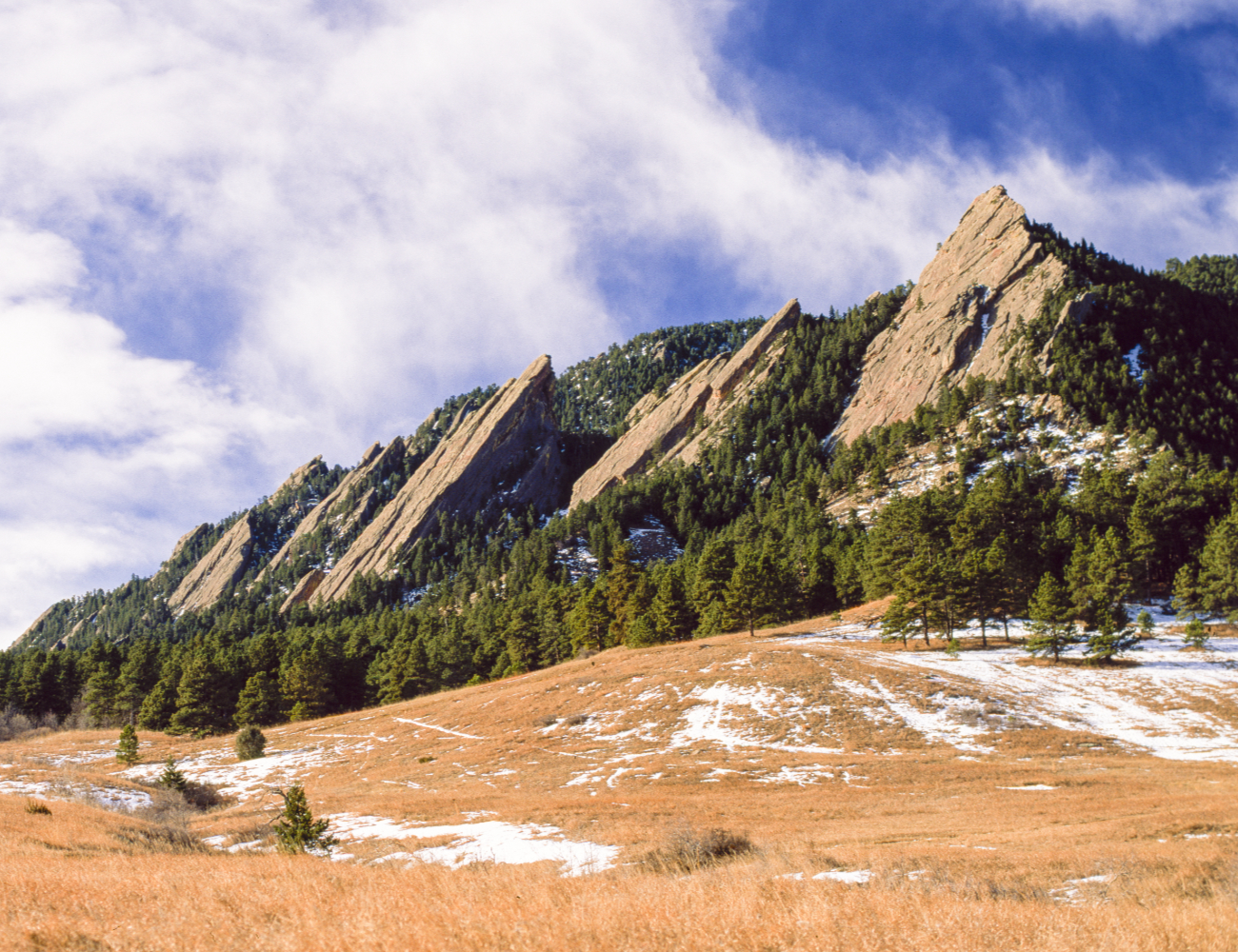
For more than ten thousand years, Indigenous peoples lived in and stewarded the Boulder Valley and the broader Colorado Front Range. By the early 1800s, the allied Southern Arapaho and Southern Cheyenne nations utilized the sheltered foothills for winter encampments. The United States Congress designated these plains as Indian Country in 1834, establishing a legal boundary that incoming gold seekers soon ignored.
Chapter 01 Key Events Timeline
- Since Time Immemorial
Indigenous Homelands
The Boulder Valley in present-day Colorado has been home to Indigenous peoples since time immemorial. The City of Boulder formally acknowledges the ancestral homelands and unceded territory of the Di De'i (Apache), Hinono'eiteen (Arapaho), Tsétsėhéstȧhese (Cheyenne), Nʉmʉnʉʉ (Comanche), Caiugu (Kiowa), Čariks i Čariks (Pawnee), Sosonih (Shoshone), Oc'eti S'akowin (Sioux) and Núuchiu (Ute) Nations.
- Late 1700s
Arapaho–Cheyenne Alliance
Pushed westward from the Great Lakes region by expanding tribes, the Arapaho and Cheyenne formed a durable alliance near the Black Hills. By 1800, the two allied nations migrated south onto the central plains and established their dominance along the Colorado Front Range.
- Early 1820s
The Birth of Nowoo3
In the early 1820s, a Southern Arapaho woman gave birth to a boy on the central plains who received the name Niwot, or Left Hand, because he favored that hand. Nowoo3 grew into an accomplished plainsman and an English-speaking chief who negotiated directly with encroaching white Americans to protect his people.
- 1833
MaHom and the English Language
In 1833, Nowoo3's sister MaHom married John Poisal, an American trader who lived in their village and tutored both Nowoo3 and his brother Neva in English. This rare education gave the brothers the exact linguistic tools they later used to interpret at treaty councils and navigate complex diplomacy.
- June 30, 1834
Indian Trade and Intercourse Act
The United States Congress passed legislation designating the lands west of the Mississippi River as Indian Country and prohibiting white settlement. This federal law legally recognized Southern Arapaho and Southern Cheyenne possession of the central plains, but the government later abandoned this promise during the Colorado Gold Rush.
- 1849
Overland Trails and Ecological Disruption
Driven by the California gold discovery, forty thousand prospectors traveled the Platte and Arkansas river routes in 1849, destroying prairie grasses and scattering buffalo herds. These wagon trains also introduced a cholera epidemic that killed hundreds of Arapaho people and wiped out half of the Southern Cheyenne nation.
Bibliography
Books, newspapers, and records that shaped this chapter.
- Berthrong, Donald J. The Southern Cheyennes. Norman: University of Oklahoma Press, 1963.
- City of Boulder. "Staff Land Acknowledgment."
- City of Boulder and Living Heritage Anthropology, LLC. "The City of Boulder Ethnographic Education Report: Cheyenne and Arapaho."
- Coel, Margaret. Chief Left Hand: Southern Arapaho. Norman: University of Oklahoma Press, 1981.
- Grinnell, George Bird. The Fighting Cheyennes. Arcadia Press, 2019 (originally published 1915).
- Hall, Frank. History of the State of Colorado, Vol. 1.
- Hyde, George E. A Life of George Bent: Written from His Letters. Edited by Savoie Lottinville. Norman: University of Oklahoma Press, 1968.
- Niwot Living History Historical Pathway. "Project Charter."
- Roberts, Gary Leland. Sand Creek: Tragedy and Symbol. PhD Dissertation, University of Oklahoma, 1984.
- Trenholm, Virginia Cole. The Arapahoes, Our People. Norman: University of Oklahoma Press, 1970.
- West, Elliott. The Contested Plains: Indians, Goldseekers, and the Rush to Colorado. Lawrence: University Press of Kansas, 1998.