Gold Rush & Dispossession
Prospectors discovered gold near present-day Denver, igniting a gold rush that drove white settlers into the Boulder Valley. Although early local histories state that Chief Nowoo3 ordered these prospectors to leave, the settlers stayed and organized claims in direct violation of the 1851 Treaty of Fort Laramie and the 1834 Indian Intercourse Act. This occupation dispossessed the Southern Arapaho and Cheyenne of lands promised to them and would soon exile the tribes from the Boulder Valley.
Chapter 02 Key Events Timeline
- September 17, 1851
Treaty of Fort Laramie
The United States signed the Treaty of Fort Laramie, recognizing Arapaho and Cheyenne ownership of the lands between the North Platte and Arkansas rivers. This protected Native territory included present-day Boulder County and Denver.
- July 1858
Gold Discovery at Dry Creek
Prospectors struck gold on a Southern Arapaho wintering ground at Dry Creek near present-day Denver. This discovery ignited the Pikes Peak gold rush and drove tens of thousands of settlers onto the plains.
- November 1858
Boulder Valley Settlement
Local histories say Thomas Aikins and his party arrived at the mouth of Boulder Canyon and built cabins on unceded Arapaho land. Chief Nowoo3 confronted the prospectors and ordered them to leave because they were destroying the tribe's timber, game, and grass. However, they stayed and several of the goldseekers would form the first city in present-day Boulder County.
- 1859
Front Range — The Fifty-Niners and Ecological Collapse
Approximately 100,000 settlers flooded the Front Range, bringing livestock that overgrazed river valleys and cutting down vital cottonwood groves for fuel and cabins. This sudden migration collapsed the bison economy and spread severe hunger and deadly diseases through Native camps.
- Mid-January 1859
The Gold Run Discovery
In mid-January 1859, prospectors from the Boulder Creek encampment discovered surface gold at Gold Run, triggering a massive rush of miners onto unceded Southern Arapaho territory. To protect their unauthorized claims on Indigenous land, these prospectors established Mountain District No. 1 at Gold Hill as the region's first extralegal mining government.
- February 10, 1859
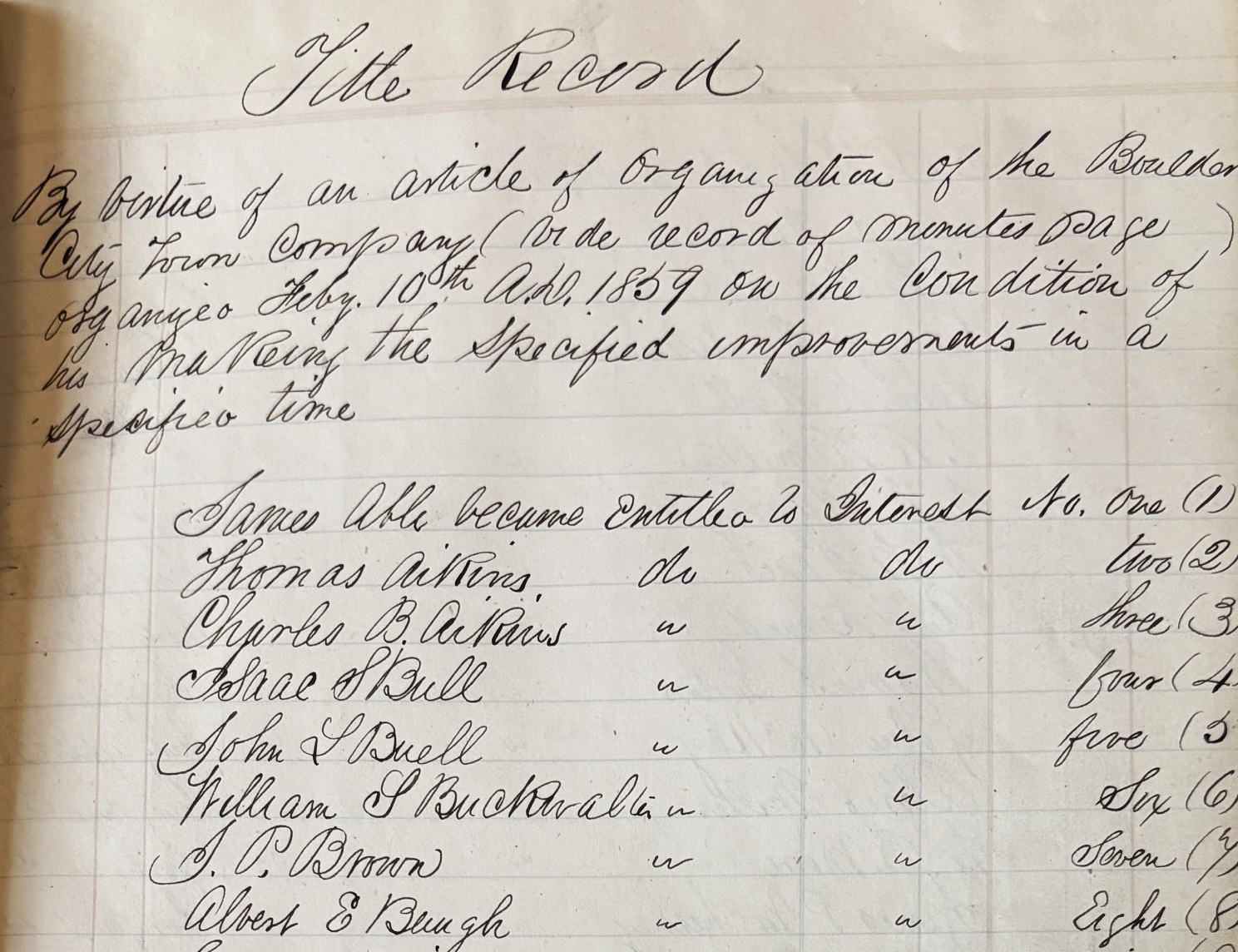
Boulder City Town Company
Fifty-six prospectors organized the Boulder City Town Company directly on Arapaho wintering grounds. The founders platted more than twelve hundred acres of unceded land into 4,044 commercial lots.
- Spring–Summer 1859
Extralegal Claim Clubs and Mountain Districts
White settlers formed extralegal organizations, including Mountain District No. 1 and the Great Western Land Claim Association, which functioned as an unauthorized recorder of deeds for the Boulder Valley. Acting as legal trespassers, these prospectors misused the federal Preemption Act of 1841 to claim 160-acre tracts, even though the law strictly prohibited settlement on unceded Native lands.
- May 1859
Indigenous Diplomacy in Denver
Southern Arapaho leaders Little Raven and Nowoo3 independently visited the new Rocky Mountain News in the expanding settler camps in present-day Denver. During a formal public council, Little Raven said the land around Denver belonged to his people and that white settlers "would not stay round here very long."
- November 1859
The Territory of Jefferson
Recognizing their lack of legal land titles, white settlers organized the extralegal Territory of Jefferson across present-day Colorado. The provisional assembly enacted unauthorized laws, established counties, and collected taxes to protect pioneer property until the federal government created Colorado Territory in 1861.
Bibliography
Books, newspapers, and records that shaped this chapter.
- Bixby, Amos. "History of Boulder County" in History of Clear Creek and Boulder Valleys, Colorado (1880).
- Coel, Margaret. Chief Left Hand, Southern Arapaho (1981).
- Gillespie, Lois M. Wright. "The Jackson (Great Western) Land Claim Association – 1859-1860: Boulder Valley Settlers Claim Tracts on Indian Land" (1994).
- Meier, Tom. The Early Settlement of Boulder Set in Type — Cast in Bronze — Fused in Porcelain. ‘It Ain't Necessarily So’ (1993).
- Roberts, Gary L. Sand Creek: Tragedy and Symbol (1984).
- Trenholm, Virginia Cole. The Arapahoes, Our People (1970).
- Rocky Mountain News Articles (1859).
- Treaties and Laws: 1851 Treaty of Fort Laramie, the 1841 Preemption Act, and the 1834 Indian Intercourse Act.