The Fort Wise Treaty & Colorado
In February 1861, federal agents secured six Cheyenne and Arapaho signatures on the Treaty of Fort Wise, an agreement that Chief Nowoo3 and the majority of tribal leaders rejected. Following the outbreak of the Civil War, Territorial Governor William Gilpin funded the construction of Camp Weld and raised the First Colorado Regiment, which would defeat Confederate forces near present-day Glorieta, New Mexico. In November 1861, the Boulder County Commissions began their first meetings to levy taxes, map voting townships and record property deeds.
Chapter 03 Key Events Timeline
- February 18, 1861
The Treaty of Fort Wise
Federal agents convinced a small faction of Cheyenne and Arapaho chiefs to sign the Treaty of Fort Wise to clear Native land claims from the Colorado mining region. The few chiefs who signed believed the agreement only bound themselves, but federal officials insisted the treaty legally committed all the bands to relocate to a new reservation.
- February 28, 1861
Congress Creates Colorado Territory
Congress passed the Organic Act creating Colorado Territory, bringing federal jurisdiction to the pioneer settlements while explicitly stating that unceded Indigenous lands were excluded from territorial boundaries. Federal officials later clarified that Indian land title remained unextinguished, meaning the thousands of gold rush prospectors who had built towns and farms were residing on unceded Native territory.
- April 12, 1861
The Outbreak of the Civil War
Confederate artillery fired on Union troops at Fort Sumter, igniting a national conflict that accelerated the expansion of the American empire on the western plains. Territorial leaders like Governor John Evans and Colonel John Chivington used the Union's need for western gold and reports of Confederate-allied uprisings to justify raising troops against the Cheyenne and Arapaho.
- August 1861
Senate Strikes Article XI
The United States Senate ratified the treaty but struck out Article XI, which would have allowed Denver residents to bypass federal law and purchase Native land directly. Because this alteration changed the legal document, federal agents had to return to the plains to secure new signatures from the Cheyenne and Arapaho leaders.
- Fall 1861
Nowoo3 Refuses the Amendment
When the Southern Arapaho and Cheyenne assembled at Fort Wise to receive their government annuities, Agent A. G. Boone withheld needed provisions promised under the 1851 treaty until the chiefs signed the Senate's treaty amendment. Chief Nowoo3 refused to sign the altered document.
- November 15, 1861
The First County Commissioners Meeting
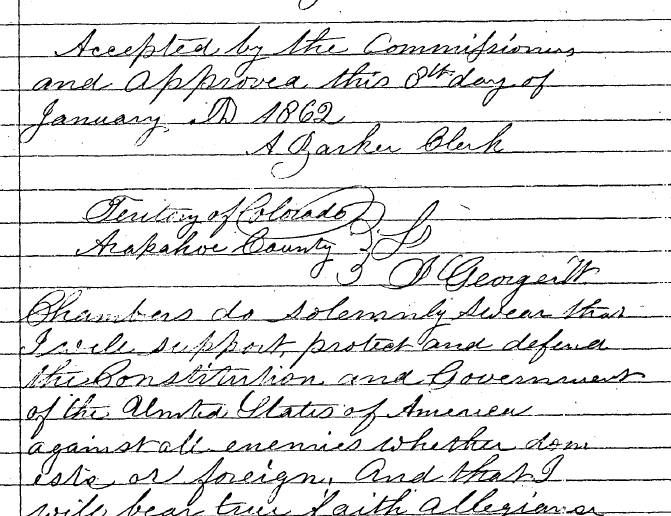
Boulder County Commissioners George W. Chambers, David P. Walling, and T. J. Graham held their inaugural meeting to divide the pioneer settlements into eight voting townships. By levying taxes, recording property deeds, and granting franchise permits for new toll roads and irrigation ditches, the commissioners established a formal legal bureaucracy over the unceded Indigenous territory.
- February-March 1862
The First Colorado Volunteers March South
The First Regiment of Colorado Volunteers marched out of Camp Weld to defend New Mexico Territory from a Confederate invasion. During the Battle of La Glorieta Pass in late March, Major John Chivington led a detachment that outflanked the enemy, destroyed the Confederate supply train, and bayoneted nearly five hundred horses and mules, a decisive victory that forced a Confederate retreat and secured Chivington's appointment as commander of the Military District of Colorado.
- Spring 1862
Governor John Evans Arrives in Denver
Appointed by President Abraham Lincoln, businessman John Evans arrived in Denver to serve as Colorado's territorial governor and Superintendent of Indian Affairs. Evans immediately adopted an interpretation of the Fort Wise Treaty that legally bound all Cheyennes and Arapahoes to surrender their land and move to the Sand Creek reservation.
Bibliography
Books, newspapers, and records that shaped this chapter.
- Carson, Dina C. (Compiler). Boulder County Commissioner's Journal 1861-1871: An Annotated Transcription. Niwot, CO: Iron Gate Publishing, 2012.
- Coel, Margaret. Chief Left Hand, Southern Arapaho. Norman, OK: University of Oklahoma Press, 1981
- Roberts, Gary Leland. Sand Creek: Tragedy and Symbol. Norman, OK: University of Oklahoma (Ph.D. Dissertation), 1984
- United States Government Documents. 1861 Treaty of Fort Wise, 1861 Organic Act of Colorado Territory, and the 1834 Indian Trade and Intercourse Act.