Expansion and the Year of Hunger
Hoping to correct the 1861 Fort Wise Treaty, Neva met directly with Governor John Evans in May 1862, but Evans rejected the protest and ordered all Cheyenne and Arapaho bands to relocate to the Sand Creek reservation by the end of the year. As Congress passed the Homestead, Pacific Railway, and Morrill acts to transfer western lands, white settlers expressed relief when federal surveyors arrived to officially record their claims. While the tribes faced starvation and disease during a severe drought in 1863, Evans reported the chiefs' absence from a fall treaty council as evidence of a hostile conspiracy and intensified his efforts to clear the plains.
Chapter 04 Key Events Timeline
- Late May 1862
Neva Confronts Governor Evans
Hoping to correct the 1861 Fort Wise Treaty, Neva met directly with Governor Evans to explain that the Southern Arapaho had been misled by their interpreter. Evans rejected this protest and appointed John Smith as the official interpreter anyway.
- Summer 1862
The Homestead, Pacific Railway, and Morrill Acts
During the summer of 1862, Congress passed the Homestead, Pacific Railway, and Morrill acts, establishing legislation that transferred millions of acres of unceded Indigenous land to white settlers, railroad corporations, and state colleges. To facilitate this transfer of the western plains, Governor Evans presented a program to extinguish remaining Native land titles in Colorado Territory but excluded the Cheyenne and Arapaho, stating the 1861 Fort Wise Treaty had already settled their claims.
- December 5, 1862
Evans Imposes a Deadline for the Fort Wise Treaty
Governor John Evans interpreted Article VI of the 1861 Fort Wise Treaty to mean that all Cheyenne and Arapaho bands had ceded their lands, regardless of whether their specific chiefs had signed the document. Evans concluded that non-signatory bands had until December 5, 1862, to report to the Sand Creek reservation to receive treaty benefits, assuming that after this deadline all bands would be bound to the reservation without compensation.
- Spring 1863
Native Delegation Tours the East
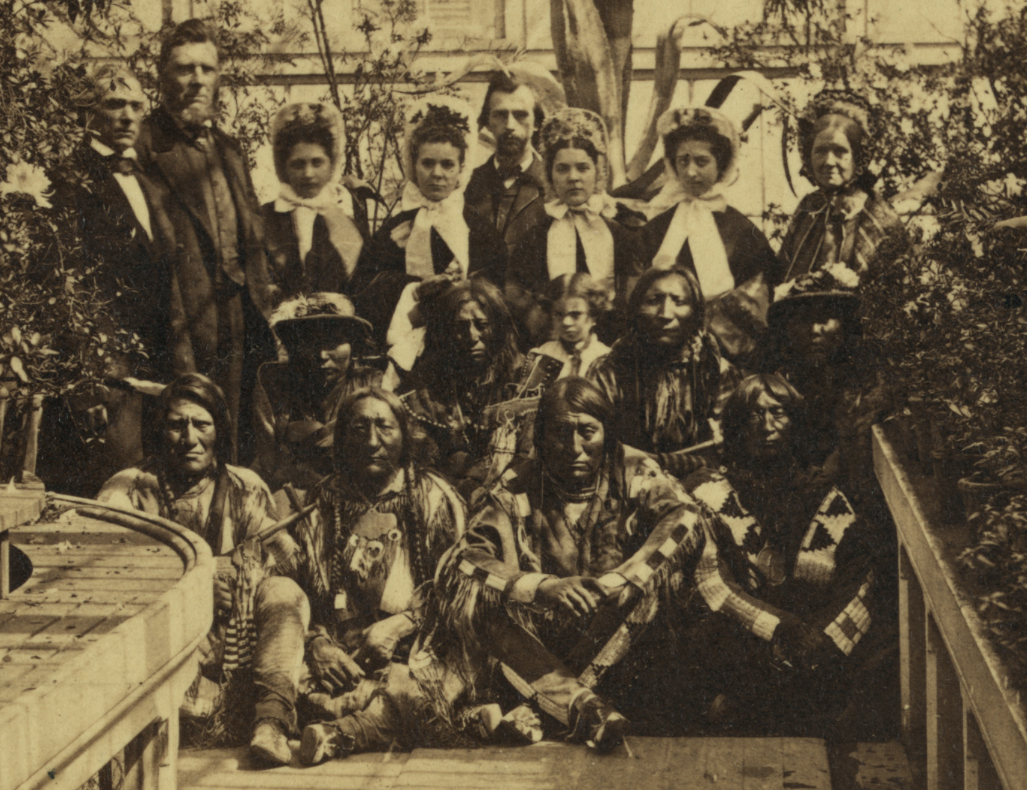
In Spring 1863, Governor John Evans ordered Agent Samuel Colley to escort a delegation of Plains Indian chiefs to Washington, D.C., but Colley intentionally left Chief Nowoo3 at Fort Lyon, prompting Nowoo3 to state they did so to prevent him from translating. Representing the Southern Arapaho in his brother's absence, Neva met and shook hands with President Abraham Lincoln at the White House before returning to the plains convinced by the massive eastern population that military resistance against white expansion would be futile.
- 1863
The Year of Hunger
Throughout 1863, drought, scarce buffalo herds, and outbreaks of whooping cough and diarrhea plunged the Southern Cheyenne and Arapaho into a period they called the "year of hunger." Agent Samuel Colley reported that the Sand Creek reservation lacked game and that starving tribes were committing depredations for survival, while Chief Nowoo3 and allied leaders maintained peaceful relations with the white settlements.
- August–September 1863
Governor Evans Fails to Hold a Council
Hoping to extinguish remaining Indigenous land claims, Governor John Evans organized a treaty council at the Arikaree Fork of the Republican River and dispatched trader Elbridge Gerry to invite the Cheyenne and Arapaho chiefs. When Native leaders did not attend—citing disease outbreaks, the scattering of their bands for the fall hunt, and the recent killing of Cheyenne warrior Little Heart at Fort Larned—Evans returned to Denver and reported their absence as proof of a hostile Indian conspiracy.
- Fall 1863
Federal Surveyors Arrive
Even though early white settlers were squatting on unceded Indigenous territory, they expressed relief when federal surveyors arrived in the fall of 1863 to map their claims. Pioneers like Morse Coffin noted that the arrival of the surveyors eased their anxieties by signaling that the U.S. government intended to secure their occupation of the land.
Bibliography
Books, newspapers, and records that shaped this chapter.
- Coel, Margaret. (1981). Chief Left Hand: Southern Arapaho. University of Oklahoma Press.
- Crifasi, Robert R. (2015). A Land Made from Water. University Press of Colorado.
- Roberts, Gary Leland. (1984). Sand Creek: Tragedy and Symbol. PhD Dissertation, University of Oklahoma.
- Trenholm, Virginia Cole. (1970). The Arapahoes, Our People. University of Oklahoma Press.
- U.S. Congress. (1862). Homestead Act, Pacific Railway Act, and Morrill Act.