Content Notice:This page includes historical accounts of violence, racism, killings, and the events that led to the Sand Creek Massacre. Some visitors may find this material difficult or emotionally challenging.
Boulder County & Sand Creek Massacre
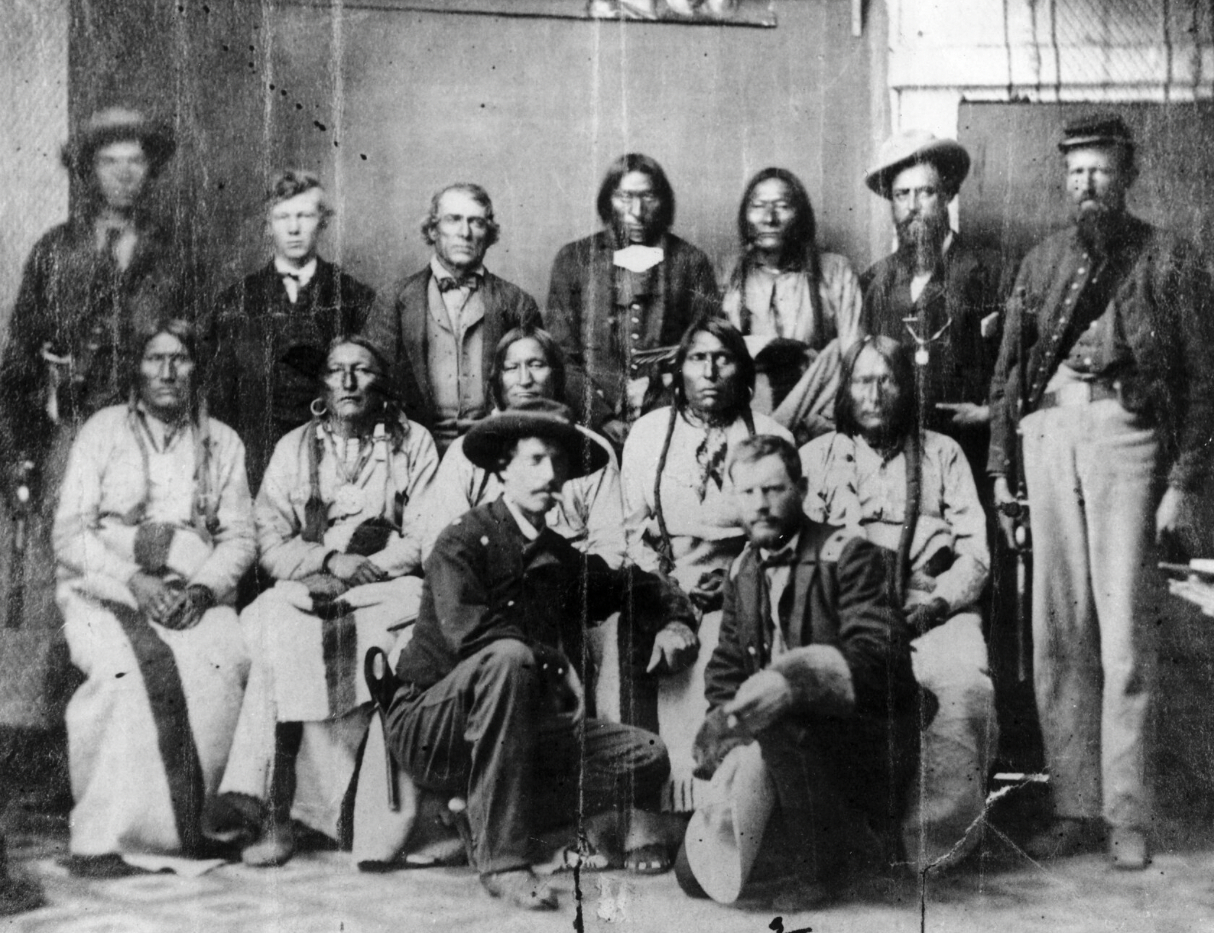
Throughout 1864, Cheyenne and Arapaho peace chiefs such as Black Kettle and Nowoo3 sought peace amid conflict provoked by the First Colorado Regiment. Amid the violence, Neva and Cheyenne chiefs sought peace at Camp Weld in Denver, but Governor John Evans and Colonel Chivington evaded their peaceful overtures. Twelve days later, Boulder County men of Company D, assembled at Fort Chambers near Boulder, killed ten Cheyenne people. On November 29, 1864, 700 men from across Colorado—including men from Boulder County—participated in the killing and mutilation of Arapaho and Cheyenne people promised military protection during the Sand Creek Massacre.
Colorado's Escalation of Violence
In the first half of 1864, Cheyenne and Arapaho bands struggled with severe starvation and sought to maintain peace on the plains. However, unprovoked attacks by Colorado military detachments from Camp Weld in Denver, coupled with prominent press coverage of settler deaths, heightened public anxiety and sparked a broader conflict.
- Early 1864
The Tribes Maintain Peace Amidst Starvation
Throughout the winter and spring of 1864, Cheyenne and Arapaho bands encamped on the plains faced starvation, as heavy burdens were placed on their food supplies, leaving horses weak and meat and robes in short supply. While the Native bands initially maintained peace and attempted to follow their traditional seasonal patterns, unprovoked attacks by soldiers disrupted their way of life, curtailed their hunting territories, and drove the starving camps together.
- April–May 1864
Unprovoked Military Attacks Spark Conflict
In the spring of 1864, soldiers launched a series of unprovoked attacks on Cheyenne camps, beginning with an April 12 firefight near Fremont's Orchard, located on the South Platte River (Note: Outside information places this east of modern-day Greeley). The violence escalated in May when Major Jacob Downing attacked a camp at Cedar Canyon, and Lieutenant George S. Eayre gunned down the peaceful Chief Lean Bear on the Smoky Hill River. Although Black Kettle prevented his warriors from destroying Eayre's retreating command, the Denver press sensationalized these skirmishes as major battles to further inflame white anxieties across the territory.
- June 11, 1864
The Hungate Family Murders
After an attack at the Van Wormer ranch southeast of Denver killed ranch manager Nathan Ward Hungate, his wife, and their two young children, the victims' mutilated bodies were brought into the city and placed on public display. The territorial press deliberately used the gruesome public display to manufacture panic and justify sweeping violence; the Weekly Commonwealth explicitly dismissed the concerns of "eastern humanitarians," arguing that the Plains tribes had "no wrongs to complain of" and demanding a "most vigorous policy" against them. Other editors fueled the hysteria by declaring the Indigenous population to be "worthless, treacherous, vindictive and hereditarily hostile," insisting that their inevitable end must be total extermination.
Governor Proclamations and Boulder County's Company D
Responding to the heightened alarm, Governor John Evans issued proclamations that authorized Coloradans to kill and destroy hostile indians that infest the plains. In Boulder County, local volunteers constructed Fort Chambers along Boulder Creek, which served as the mobilization and training headquarters for Company D as they prepared for military action.
- June 27, 1864
Governor Evans Directs "Friendly" Bands to Military Posts
Governor John Evans issued a proclamation directing all friendly Arapahoes and Cheyennes to separate themselves from hostile bands and report to designated military posts, including Fort Lyon—situated on the Arkansas River about five miles east of Las Animas—to receive provisions and a place of safety. Native peace chiefs interpreted this directive as a guarantee of sanctuary, leading them to ultimately concentrate their camps near the forts to avoid being killed during the military's ongoing campaigns.
- Late June 1864
Boulder County Militia Constructs Fort Chambers
Following reports of hostilities, local militiamen began building Fort Chambers, an adobe fortification measuring 100 by 250 feet with a central blockhouse designed to shelter two hundred fighting men and their families. Located a few miles below Boulder City, the installation later served as a training camp and headquarters for Company D of the Third Colorado Cavalry, which was the very regiment raised by Governor Evans specifically to chastise the Native tribes.
- August 1864
Governor Evans Sanctions Unrestricted Warfare
As panic over severed supply lines paralyzed the territorial capital, Governor Evans published an "Appeal to the People" on August 10, 1864, officially encouraging civilian vigilantes by declaring that any man who killed a hostile Native person was a patriot. The following day, Evans issued a second executive proclamation authorizing all Colorado citizens to kill hostile Native people on sight and seize their property as a private reward. This directive effectively stripped Indigenous people of legal protections and sanctioned unrestricted warfare, which critics later identified as a literal permit to massacre peaceful camps. Concurrently, Evans received federal authorization to raise a regiment of one-hundred-day volunteers—the Third Colorado Cavalry—mobilizing a military force specifically raised to kill Native people before their brief enlistments expired.
- Mid-August 1864
David H. Nichols Recruits Company D
Colonel John M. Chivington commissioned prominent settler David H. Nichols to recruit Company D of the Third Colorado Cavalry from Boulder Valley. Nichols drew heavily from preexisting local militias to muster one hundred men at Fort Chambers. The prevailing sentiment among the recruits demanded a total war of extermination, with volunteers openly expressing the view that neither sex nor age should be spared.
- August 23 – September 3, 1864
The Press Champions Boulder County's Militarization
As territorial newspapers celebrated the regional mobilization, editor William Byers used the Rocky Mountain News to fuel the militarization. Byers and other editors explicitly championed the militia's response, praising the community for nobly mustering men into service—propaganda that encouraged white settlers to view the campaign against the Plains tribes as a heroic civic duty.
Peace Overtures and the Buffalo Springs Attack
While Cheyenne and Arapaho chiefs actively sought peace through councils in Denver, military and political leaders avoided formal treaties and directed them to gather at Fort Lyon. As the tribes awaited federal orders, volunteer troops like Company D attacked a Cheyenne camp at Buffalo Springs and killed 10 Cheyenne and Arapaho People.
- September 1864
Major Wynkoop Negotiates Peace and Escorts the Chiefs to Denver
Responding to a written plea for peace from Chief Black Kettle, Major Edward Wynkoop led a military expedition deep into Cheyenne and Arapaho territory to negotiate a prisoner exchange. During a tense council at the Smoky Hill encampment where Black Kettle actively restrained militant warriors, Wynkoop admitted he lacked treaty-making authority but successfully demanded the release of white captives as proof of the tribes' peaceful intentions. After the captives were surrendered, Wynkoop escorted Black Kettle and other peace chiefs on an unauthorized journey to Denver, placing the delegates in physical danger while forcing a reluctant Governor Evans into a public council he had tried to avoid.
- September 28, 1864
The Camp Weld Council Evades Peace Overtures
Governor Evans and Colonel Chivington met with the delegation of Cheyenne and Arapaho chiefs at Camp Weld. Black Kettle, White Antelope, and Bull Bear represented the Cheyennes; Neva, Bosse, Heap of Buffalo, and Na-ta-nee represented the Arapahoes. Evans refused to negotiate a formal treaty, claiming he lacked civilian authority to end an active war, and shifted all diplomatic responsibility to the military. Colonel Chivington abruptly ended the council by stating his rule was to fight until they submitted to military authority, directing the chiefs to Major Wynkoop at Fort Lyon. This deceptive directive left the Native leaders falsely believing they had secured military sanctuary if they went to the fort.
- October 10, 1864
Boulder's Company D Massacres a Surrendering Cheyenne Camp
After receiving news that a Cheyenne warrior was seen near the Wisconsin Ranch, Captain David H. Nichols rapidly organized a detachment of Company D and rode out to locate the Native camp. Arriving at the sand hills of Buffalo Springs (Note: Outside information places this near present-day Sterling) the next morning, the Boulder County troops surrounded the two small lodges belonging to Cheyenne Chief Big Wolf. Captain Nichols directed his men to open fire, ignoring the Cheyennes' white flag of surrender, and shot down five men, three women, and two children. Lieutenant Colonel Leavitt L. Bowen later proudly celebrated the unprovoked massacre as proof that the Third Regiment could no longer be mocked as the "bloodless Third."
- Mid-November 1864
The Transition Council Endorses the Peace Policy
Major Edward Wynkoop convened a formal transition council with about sixty Cheyenne and Arapaho headmen, assuring them that the new commander would uphold the established peace policies. Major Scott J. Anthony explicitly pledged that the army would work toward securing a permanent peace and advised the tribes to remain at their Sand Creek encampment until he received final federal orders. However, Anthony secretly intended to attack the camps once sufficient troops arrived, later admitting in reports that he only sought to lull their suspicions and keep matters dormant until reinforcements could take the field.
- Late November 1864
Nowoo3 Relocates His Band to Sand Creek
Suffering from severe illness and unable to undertake a long winter migration, Arapaho Chief Nowoo3 (Left Hand) chose not to follow Little Raven south of the Arkansas. Instead, Nowoo3 maintained his commitment to the peace process, moving his family and a small band of eight to ten lodges to join Black Kettle's encampment at Sand Creek. By complying with military instructions to await General Curtis's orders, the Arapaho peace chief unwittingly placed his most vulnerable followers directly in the path of Colonel Chivington's coming force.
The Sand Creek Massacre
Disregarding the protests of dissenting officers, Colonel John M. Chivington's forces launched a surprise attack on the surrendered camp. The resulting assault killed approximately two hundred Cheyenne and Arapaho people, severely damaging tribal leadership and leaving an enduring legacy of trauma.
- November 28, 1864
Officers Vehemently Protest the Planned Attack
Following a covert march across snow-covered plains, Colonel John M. Chivington's command surprised the garrison at Fort Lyon on the morning of November 28, 1864, immediately sealing the post with a picket line to prevent anyone from warning the Native camps. As the expeditionary force prepared, Captain Silas Soule vehemently condemned the operation, declaring to his fellow officers that any man who participated in murdering the peaceful camps was a coward, which prompted Chivington to threaten him with hanging. That evening at the commissary, Lieutenant Joseph A. Cramer, supported by other dissenting officers, directly confronted Chivington and warned him that attacking the surrendered camp constituted murder. Enraged by the opposition, Chivington paced the room and cursed any man sympathetic to the Native people—a confrontation these whistleblowing officers later courageously recounted under oath before the 1865 military commission, an act of defiance that cost Soule his life to an assassin just months later.
- November 29, 1864 (Dawn & Morning)
Troops Ignore Flags of Truce and the Camps Flee
Cheyenne and Arapaho families awoke to the sound of pounding hoofbeats, initially hoping a herd of bison was nearby before realizing cavalry had arrived to attack them. As the troops charged the village, Chief Black Kettle desperately hoisted an American flag and a white flag of surrender. Chief White Antelope stood with his arms folded and sang his death song before being gunned down. Lieutenant Joseph Cramer later testified that Arapaho Chief Nowoo3 (Left Hand) also stood bravely with his arms folded, declaring he would not fight the soldiers because they were his friends, just before he was shot. While some members of the Boulder detachment firmly believed they had killed the Arapaho leader during the initial chaos, historical records confirm Nowoo3 survived the immediate assault, was carried from the battlefield by fleeing survivors, and died days later. Terrified survivors fled northward up the dry creek bed, desperately digging shallow pits in the sandy banks to hide from the onslaught. Amid the chaotic slaughter, officers like Captain Silas Soule and Lieutenant Cramer courageously held their men back and refused to fire, an act of defiance they later testified to under oath.
- November 29, 1864 (Afternoon)
The Slaughter and Mutilations
By the time the active shooting subsided, troops had murdered approximately two hundred peaceful Cheyenne and Arapaho people, with Captain Soule noting that the vast majority were women and children. Henry C. Foster and Robert McFarland died while participating in the massacre. As fighting waned, volunteer troops systematically scalped the dead and committed horrific atrocities, which included bashing in children's skulls and mutilating bodies. Dissenting officers later preserved these gruesome details in sworn testimony during the 1865 federal inquiries.
- November 29, 1864 (Aftermath)
A Devastating Blow to Tribal Leadership
The unprovoked attack resulted in the murder of at least twenty-three Cheyenne chiefs and five Arapaho chiefs, including White Antelope, One Eye, War Bonnet, Left Hand, Heap of Buffalo, Neva, Knock Knee, and Bull Bear. According to Tribal Elders, this sudden extermination of political, religious, and cultural leadership inflicted a devastating organizational blow comparable to the entire United States government being eliminated in a single day. Without their strong voices and leadership, the Cheyenne and Arapaho people were left deeply traumatized and even less able to resist the military campaigns and forced removals that followed the massacre.
Heroes' Welcome and Investigations
Following the attack, the military's pursuit of fleeing bands ended in failure, and while returning troops were initially hailed as heroes in Denver, whistleblowers immediately reported the reality of the events to federal authorities. These firsthand accounts contradicted the military's claims and quickly prompted congressional and military investigations.
- December 1–7, 1864
The Pursuit of Little Raven Ends in Exhausted Horses
Following the attack at Sand Creek, Colonel Chivington mobilized the Third Colorado—including the Boulder volunteers of Company D—south toward the Arkansas River in pursuit of Little Raven's Southern Arapaho band. The cavalry tracked the fleeing families for several days, frequently arriving at hastily abandoned campsites just miles behind their quarry. Colonel George L. Shoup and other officers soon concluded that their horses were too worn out to continue the pursuit. The command abandoned the expedition on December 7 when their mounts became completely exhausted, allowing Little Raven's people to survive. (Coffin, 1965; Roberts, 1984)
- December 1864
Indian Agent Colley Demands a Federal Inquiry
Indian Agent Samuel G. Colley bypassed the Colorado press and reported the attack directly to federal officials in Washington. Colley penned protest letters to Commissioner of Indian Affairs William P. Dole, Secretary of the Interior John P. Usher, and Senator James R. Doolittle, chairman of the Senate Indian Affairs Committee. He emphasized that the Cheyenne and Arapaho leaders had done everything possible to keep the peace. He further testified that they were encamped under military protection when Chivington attacked. (Roberts, 1984)
- December 9–26, 1864
Harding's Leak Breaks the Story in the East
Colorado Chief Justice Stephen S. Harding leaked details of the unprovoked attack to his political contacts in Washington. The correspondence resulted in an anonymous article published in the New York Herald on December 26, 1864, which sparked widespread eastern outrage. This exposure heavily contradicted Chivington's public claims of a glorious military victory. When Chivington's supporters in Denver exposed Harding as the author of the leak, they subjected the chief justice to intense public and political pressure that eventually forced his resignation from the territorial bench. (Roberts, 1984)
- December 14–19, 1864
Soule and Cramer Write to Wynkoop to Expose Atrocities
Captain Silas Soule and Lieutenant Joseph Cramer wrote detailed letters from Fort Lyon to Major Wynkoop documenting the atrocities committed by Chivington's troops. The dissenting officers provided firsthand accounts of the attack on the surrendered camp. They explicitly described soldiers mutilating the dead and killing young children. Wynkoop forwarded these reports to military headquarters and federal officials, providing the crucial primary evidence that would spark official congressional and military investigations. (Roberts, 1984; Soule & Cramer Letters, 1864)
- December 22, 1864
The "Bloody Third" Receives a Heroes' Welcome
Colonel Chivington led the Third Regiment—now calling themselves the "Bloody Third"—on a triumphal march through the streets of Denver to the cheers of the public. The returning cavalrymen were welcomed as heroes and crowded the city's bars, hotels, and stores to regale citizens with accounts of a military victory. Over the following weeks, the soldiers publicly displayed Native scalps and severed body parts as victory trophies. They festooned local saloons and exhibited the remains on stage at the Denver Theater. (Arapaho-Cheyenne Tribal Elders & History Colorado, 2022; Roberts, 1984)
- December 29, 1864
Word of a Congressional Investigation Reaches Colorado
The Rocky Mountain News published a brief Washington dispatch announcing a congressional investigation into the "affair at Fort Lyon" based on reports from high officials that surrendered women and children had been killed. The announcement shocked the majority of Colorado citizens, who viewed the Sand Creek attack as a justified act of self-defense and considered the impending federal investigation an assault on their community. Veterans and local politicians immediately began speculating about the identities and motives of the "high officials" who had reported the events to Washington. The controversy ignited a bitter political struggle that would dominate territorial politics for years to come. (Roberts, 1984)
Bibliography
Books, newspapers, and records that shaped this chapter.
- Arapaho-Cheyenne Tribal Elders, & History Colorado. (2022). The Sand Creek Massacre: The betrayal that changed Cheyenne and Arapaho people forever. History Colorado.
- Berthrong, D. J. (1963). The Southern Cheyennes. University of Oklahoma Press.
- Coffin, M. H. (1965). The battle of Sand Creek (A. W. Farley, Ed.). W. M. Morrison Publisher.
- Crifasi, R. R. (2015). A land made from water: Appropriation and the evolution of Colorado's landscape, ditches, and water institutions. University Press of Colorado.
- Grinnell, G. B. (2019). The fighting Cheyennes. Arcadia Press. (Original work published 1915).
- People of the Sacred Land. (n.d.). Truth, restoration & education report: Legal and political history of Colorado tribes (Part II).
- Roberts, G. L. (1984). Sand Creek: Tragedy and symbol.
- Roberts, Gary Leland. (1984). Sand Creek: Tragedy and Symbol. University of Oklahoma.
- Hyde, George E. (1968). Life of George Bent. University of Oklahoma Press.
- History Colorado. (2022). The Sand Creek Massacre: The Betrayal That Changed Cheyenne and Arapaho People Forever.
- Truth, Restoration, and Education Commission of Colorado [TREC]. (2023). Fraud Report.
- U.S. Congress, Joint Committee on the Conduct of the War. (1865). Massacre of the Cheyenne Indians.