Investigations & Condemnation
Following the Sand Creek Massacre, returning troops received a heroes' welcome in Denver, where theatrical productions exhibited Indigenous scalps and captive children to cheering audiences. As a massive military coalition of Cheyenne, Arapaho, and Sioux warriors launched devastating retaliatory raids across the plains, local settlers mobilized to politically defend the massacre. Despite procedural challenges and intense public hostility, a military commission in Denver and a congressional committee in Washington gathered sworn testimony from dissenting officers, eventually releasing reports that thoroughly documented the atrocities and condemned the military commanders.
Chapter 06 Key Events Timeline
- January–February 1865
Retaliatory Raids Sweep the Plains
Following the Sand Creek massacre, Southern Cheyenne, Northern Arapaho, and Sioux warriors formed a military coalition to launch retaliatory strikes against the overland transit routes. On January 7, 1865, a force of approximately one thousand warriors attacked the stage station at Julesburg, Colorado, and completely severed the overland telegraph lines. The warriors sacked the town and extracted massive quantities of supplies while soldiers and stagecoach operators barricaded themselves inside Fort Rankin. Following the initial raids, the allied tribes withdrew their families northward toward the Powder River country.
- January 27, 1865
Boulder Sounds the First Gun in Defense of Sand Creek
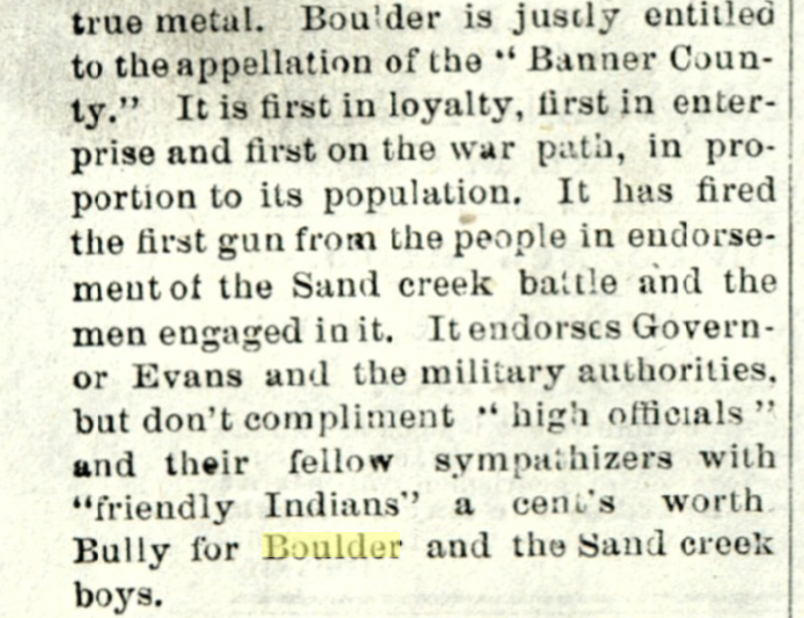
In late January 1865, the local settler population of Boulder County mobilized to politically defend the military actions at Sand Creek. Citizens held a public meeting to formally endorse the attack on the Cheyenne and Arapaho encampment. The Rocky Mountain News praised the residents for their support, declaring that Boulder fired the first gun from the people in endorsement of the Sand Creek battle and the men engaged in it.
- February–May 1865
The Military Investigation Gathers Sworn Testimony
In February 1865, military officials convened a formal fact-finding commission in Denver led by Lieutenant Colonel Samuel F. Tappan, whom Chivington formally objected to as an avowed enemy, though the inquiry already lacked the authority to court-martial Chivington because he had mustered out of the military. Because the commission's transcripts were not released to the press, citizens were prevented from hearing the facts of the massacre as they emerged. During the investigation, Captain Silas Soule and Lieutenant Joseph A. Cramer successfully testified that prior to the attack, they had confronted Colonel Chivington and Major Scott J. Anthony to remind them of the military's explicit pledges of protection, warning that attacking the encampment constituted a betrayal and murder.
- March–July 1865
The Congressional Investigation Releases a Damning Report
In Washington, D.C., the Joint Committee on the Conduct of the War launched a congressional investigation into the Sand Creek attack and interrogated Governor John Evans regarding his administration. In the summer of 1865, the committee released a sweeping report that condemned the attack as a brutal and unprovoked slaughter. The report officially validated the peaceful intentions of the targeted Cheyenne and Arapaho bands and branded the military commanders as perpetrators of brutal and cowardly crimes. The committee concluded its report by recommending the immediate removal of Governor Evans from office and the arrest of Colonel Chivington.
- April 23, 1865
Charles Squires and William Morrow Assassinate Captain Silas Soule
On the evening of April 23, 1865, Charles W. Squires and William Morrow, two soldiers of the Second Colorado Cavalry, waited for Captain Silas Soule near a church on Lawrence Street in Denver. As Soule approached, an exchange of gunfire occurred, during which Soule wounded Squires in the hand before being shot in the head and killed. Following the shooting, the two soldiers returned to their camp, confessed to shooting an officer who had previously incarcerated Squires, and deserted the military. Morrow fled down the Platte River, while Squires fled south toward New Mexico.
- May–October 1865
The Arrest and Escape of Charles Squires
In May 1865, authorities arrested Charles Squires in Las Vegas, New Mexico, and eventually transported him back to Denver in irons. In October 1865, a general court-martial convened in Denver to try Squires for the murder of Captain Soule and for deserting the military. Before the trial concluded, Squires escaped from the provost guardhouse on the evening of October 9, 1865, with outside assistance that included picking the padlock and providing chisels to remove his shackles. Squires fled the territory and was never brought to justice for the assassination.
- May 30, 1865
Judge Advocate General Holt Condemns the Massacre
On May 30, 1865, the military commission concluded its investigation, resulting in a detailed review by Judge Advocate General Joseph Holt. Holt condemned the attack as a cowardly and cold-blooded slaughter and deplored that Colonel John M. Chivington remained beyond the reach of a formal military trial. However, the federal government did not publish the eight hundred pages of official testimony until 1868, and Holt's strong condemnation never appeared in the public press. Because the full testimony remained unpublished, the citizens of Colorado never saw the complete case against the military commanders.
- June 1865
Chivington Publishes His Synopsis and the Press Defends the Campaign
Because the commission's transcripts were withheld, Colonel Chivington relied instead upon publishing a pamphlet titled "Synopsis" in June to publicly defend his actions. The Rocky Mountain News actively defended the soldiers' conduct, and its junior editor, John L. Dailey, had enlisted as a private and later served as a lieutenant in the Third Regiment during the Sand Creek campaign. Following the investigations, editor William N. Byers served as an architect of the standard public defense of Sand Creek and utilized the newspaper in Denver to justify the events.
- July–August 1865
President Johnson Forces Governor Evans to Resign
On July 18, 1865, Secretary of State William H. Seward formally requested the resignation of Governor John Evans on behalf of the president. Secretary Seward subsequently informed Bishop Matthew Simpson at Cape May, New Jersey, that the federal administration could not retain Evans in office without causing trouble in Congress due to the recently published report of the Joint Committee on the Conduct of the War. On August 1, 1865, Evans resigned his post under protest and wrote to the Secretary of the Interior requesting a delay in the transfer of power until he had completed treaty negotiations with the Ute Indians. Following the resignation, the federal government appointed Alexander Cummings to replace Evans as the territorial governor.
- Summer 1865
The Doolittle Committee Faces the Mob
In the summer of 1865, Senator James R. Doolittle led a federal committee to Fort Lyon, where members physically inspected the site of the massacre and found the skulls of murdered infants perforated with pistol and rifle shots. Senator Doolittle subsequently traveled to Denver and appeared at the Denver Theatre on July 21 to discuss the Indian question and advocate for a humane policy. During the address, the pioneer audience repeatedly interrupted him with overwhelming shouts demanding the extermination of the tribes.
- Fall 1865
The Sand Creek Vindication Party Emerges
In the fall of 1865, Colorado politicians organized the Union Administration party around an explicit political platform defending the Sand Creek campaign, pledging that the party would not support any candidate who sympathized with the Indians or who had criticized the attack. Meanwhile, hard-line veterans calling themselves the "Sand Creek Vindication Party" mobilized to ensure candidates staunchly defended the military's actions. During the local territorial elections, Colonel John M. Chivington ran for Congress as an independent candidate upon a 23-point platform that specifically promised to vindicate the actions at Sand Creek. Just days before the election, Chivington withdrew his name from the race and threw his support to the regular Union nominee, stating he was content to leave the vindication of Sand Creek to the voice of the voters.
Bibliography
Books, newspapers, and records that shaped this chapter.
- Arapaho-Cheyenne Tribal Elders & History Colorado. (2022). The Sand Creek Massacre: The betrayal that changed Cheyenne and Arapaho people forever. History Colorado.
- Berthrong, D. J. (1963). The Southern Cheyennes. University of Oklahoma Press.
- Grinnell, G. B. (2019). The fighting Cheyennes. Arcadia Press. (Original work published 1915).
- Roberts, G. L. (1984). Sand Creek: Tragedy and symbol.
- Soule, S., & Cramer, J. (1864). Letters to Edward Wynkoop. Sand Creek Massacre National Historic Site Colorado. National Park Service.
- Rocky Mountain News (January 4, 1865). "Local Items".
- Rocky Mountain News (January 27, 1865). "Sound".
- Daily Mining Journal (April 24, 1865). "Assassination of Capt. Soule".
- Rocky Mountain News (April 24, 1865). "The Homicide Last Night".
- Rocky Mountain News (June 13, 1865). "Local Items".
- Daily Mining Journal (October 10, 1865). "Telegraph Dispatches".
- Rocky Mountain News (October 10, 1865). "Another Jail Delivery".
- Rocky Mountain News (October 18, 1865). "Platform: Adopted by the Union Administration State Convention, Oct. 17, 1865".
- Rocky Mountain News (November 8, 1865). "Withdrawal of Col. Chivington".