Removal & Niwot's Founding
After the Sand Creek Massacre, the federal government formally repudiated the attack in the 1865 Treaty of the Little Arkansas, yet never paid the reparations it promised to the survivors. Two years later, the Medicine Lodge Treaty forced the Southern Arapaho and Southern Cheyenne to cede their remaining lands in Colorado and relocate to a reservation in Indian Territory. During the 1870s, as military campaigns pushed the last remaining Arapaho and Cheyenne families south to the new reservation, white settlers founded the town of Niwot, naming it for the Arapaho chief whose people had been permanently driven from the valley.
Chapter 07 Key Events Timeline
- August 15–18, 1865
The Tribes Sign a Preliminary Truce
In mid-August 1865, Cheyenne and Arapaho leaders, including Black Kettle and Little Robe, traveled to the mouth of the Little Arkansas River to negotiate with federal commissioners. On August 18, the chiefs signed a preliminary truce agreeing to cease hostilities against frontier settlements and travelers on the Santa Fe Trail. Within the truce document, the United States commissioners formally recognized the Sand Creek Massacre as the direct cause of the recent Indian hostilities.
- October 12–14, 1865
General Sanborn Apologizes at the Treaty of the Little Arkansas
Federal commissioners and tribal delegates convened near present Wichita, Kansas, where Major General John B. Sanborn opened the peace council by conceding that Colonel Chivington's actions had forced the tribes into war. Although Chief Black Kettle expressed reluctance because most Cheyenne people were absent, he and other peace chiefs signed the Treaty of the Little Arkansas on October 14, 1865. The treaty officially repudiated the Sand Creek Massacre and forced the tribes to cede their remaining lands in Colorado for a new reservation. However, the federal government never fulfilled the treaty's promises of financial indemnities and 160-acre land grants to the massacre survivors.
- October 28, 1867
The Medicine Lodge Treaty
On October 28, 1867, Southern Cheyenne and Arapaho leaders, including Sand Creek survivors Chief Black Kettle and Chief Little Raven, signed the Medicine Lodge Treaty to replace the 1865 Treaty of the Little Arkansas. The treaty relocated the tribes to a smaller joint reservation in Indian Territory while clearing the way for railroad construction across the central plains. To secure the signatures, federal commissioners promised the Cheyenne leaders they could continue to range and hunt buffalo north of the Arkansas River until the herds disappeared.
- November 27, 1868
Custer Kills the Sand Creek Survivors at the Washita
At dawn on November 27, 1868, Lieutenant Colonel George Armstrong Custer and the Seventh Cavalry executed a surprise attack on Chief Black Kettle's Cheyenne village along the Washita River. The troops shot and killed Chief Black Kettle and his wife, Medicine Woman Later—both of whom had survived Sand Creek four years earlier and actively advocated for peace—as they tried to escape across the freezing river. The troops killed dozens of other innocent Cheyenne people during the attack. Following the destruction of the village, the military strategy dictated the capture and execution of the Cheyenne pony herds to immobilize the survivors.
- August 10, 1869
President Grant Assigns a New Reservation
On August 10, 1869, President Ulysses S. Grant issued a formal proclamation assigning a new reservation to the Southern Arapahoes and Cheyennes. The executive order located the permanent reservation in Indian Territory, bounded by the Cimarron River and the ninety-eighth meridian on the east. This federal action legally confined the tribes to the south, far removed from the site of the Sand Creek Massacre and their former hunting grounds in Colorado.
- 1869–1875
Forced Removal to Indian Territory
Following the treaties, many Cheyenne and Arapaho bands resisted confinement and attempted to remain in their traditional hunting territories. In response, the United States military launched a series of campaigns, destroying villages and supplies to force the remaining bands south. By the spring of 1875, relentless military pressure, starvation, and the systematic destruction of the buffalo herds forced the last resistant bands to surrender and relocate to Indian Territory.
- January–July 1873
Railroad Secures the Right of Way
In January 1873, the Colorado Central Railroad secured the right of way for new tracks through land owned by Elijah and Nancy Williams in the present-day Niwot area. That July, Ambrose Spencer Murray Jr., the representative handling the land acquisitions, purchased the property from the Williams family for five thousand dollars, maintaining the railroad's right of way through the land.
- March 30, 1875
Niwot Is Platted and Named for Nowoo3
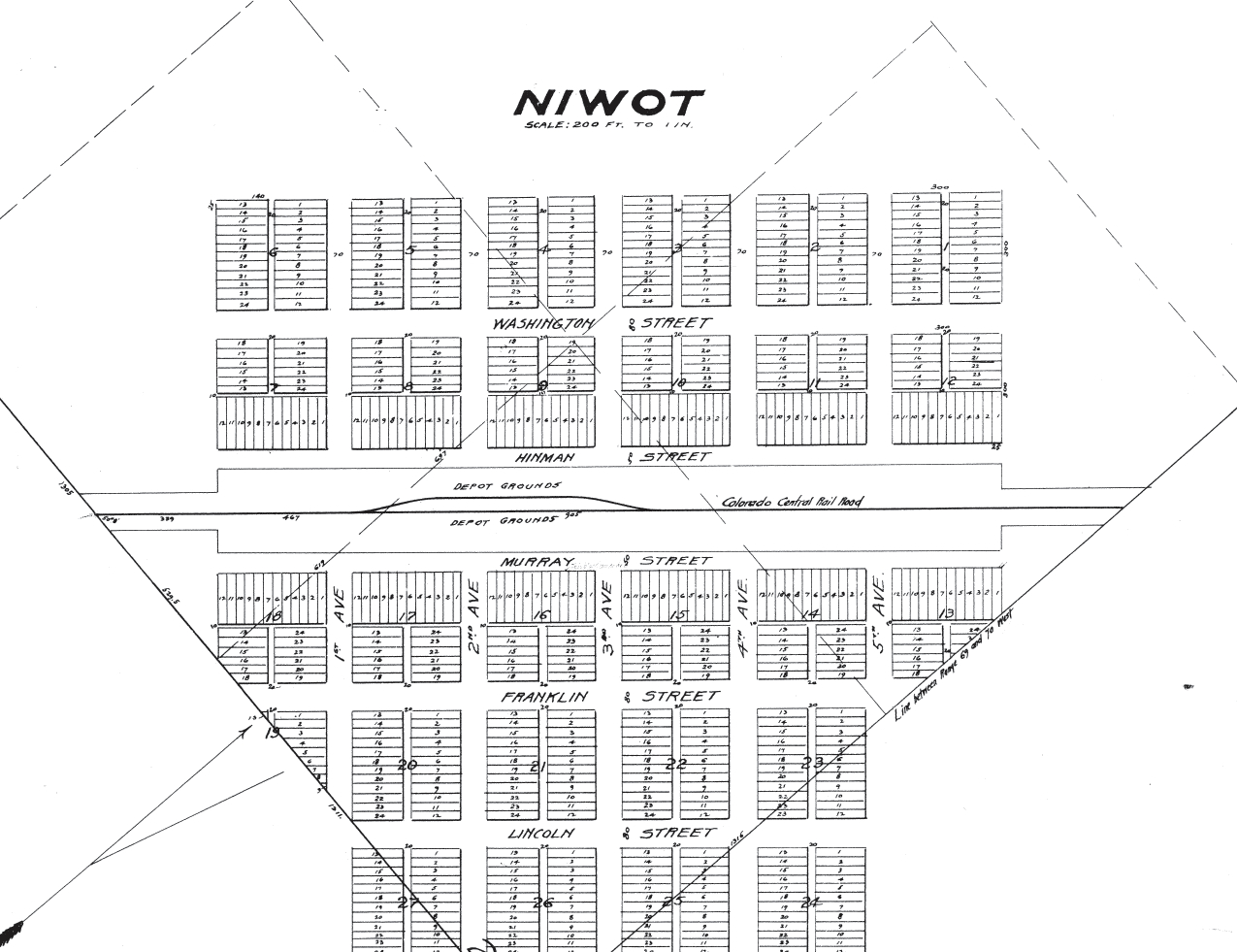
On March 30, 1875, Porter M. Hinman and Ambrose S. Murray Jr. signed the official platting map for the town of Niwot. The founders named the settlement after Southern Arapaho Chief Nowoo3, whose name translates to Left Hand in English. Eleven years before platting the town, Porter M. Hinman served as a corporal in Company D of the Third Colorado Cavalry, a Boulder County unit that participated in the Sand Creek Massacre. Although local settlers adopted the chief's name for their town, the Arapaho people had already been permanently driven from their traditional homelands in the region.
Bibliography
Books, newspapers, and records that shaped this chapter.
- Arapaho-Cheyenne Tribal Elders & History Colorado. (2022). The Sand Creek Massacre: The betrayal that changed Cheyenne and Arapaho people forever. History Colorado.
- Berthrong, D. J. (1963). The Southern Cheyennes. University of Oklahoma Press.
- Bixby, A. (1880). History of Boulder County in History of Clear Creek and Boulder Valleys.
- Grinnell, G. B. (2019). The fighting Cheyennes. Arcadia Press. (Original work published 1915).
- Koehler, K. (n.d.). Niwot: The Spirit of Colorado.
- People of the Sacred Land. (n.d.). Truth, restoration & education report: Legal and political history of Colorado tribes (Part II).
- Perrigo, L. I. (1946). A Municipal History of Boulder.
- Roberts, G. L. (1984). Sand Creek: Tragedy and symbol.
- Rosters - 3rd Regiment Roster. (n.d.).
- Rosters - 3rd Regiment, National Park Service. (n.d.).
- Trenholm, V. C. (1970). The Arapahoes, Our People. University of Oklahoma Press.